
From the Archives
23: Spearfinger, or “Time Passages”
It is difficult to conceptualize what mapped cryptids must feel, at least those who are painted with brushes of humanity to their personalities. Perhaps, as has been suggested to me by other casters, they don’t feel anything more than a mild disconnect between what was and what is. And this, I can understand—I have reached an age where “Just the other day” means last week, last year, or before you were born, depending on how well I recall. Time doesn’t so much slip away as it escapes like a thief who robs you of a few items here and there until one day, much to your surprise, you notice your home is half-vacant.
So it might be for some of these cryptids we claim.
Only 979 tales to go.
I see a light, I see it. Such a little dot, but it grows bigger and bigger while I stare into it like it is the sun. Then I’m out of the blackness. Here I am! I shrink my size with deliberation. I’m just a little old woman now, an elder with a hidden hand and a crooked smile that begs to be trusted.
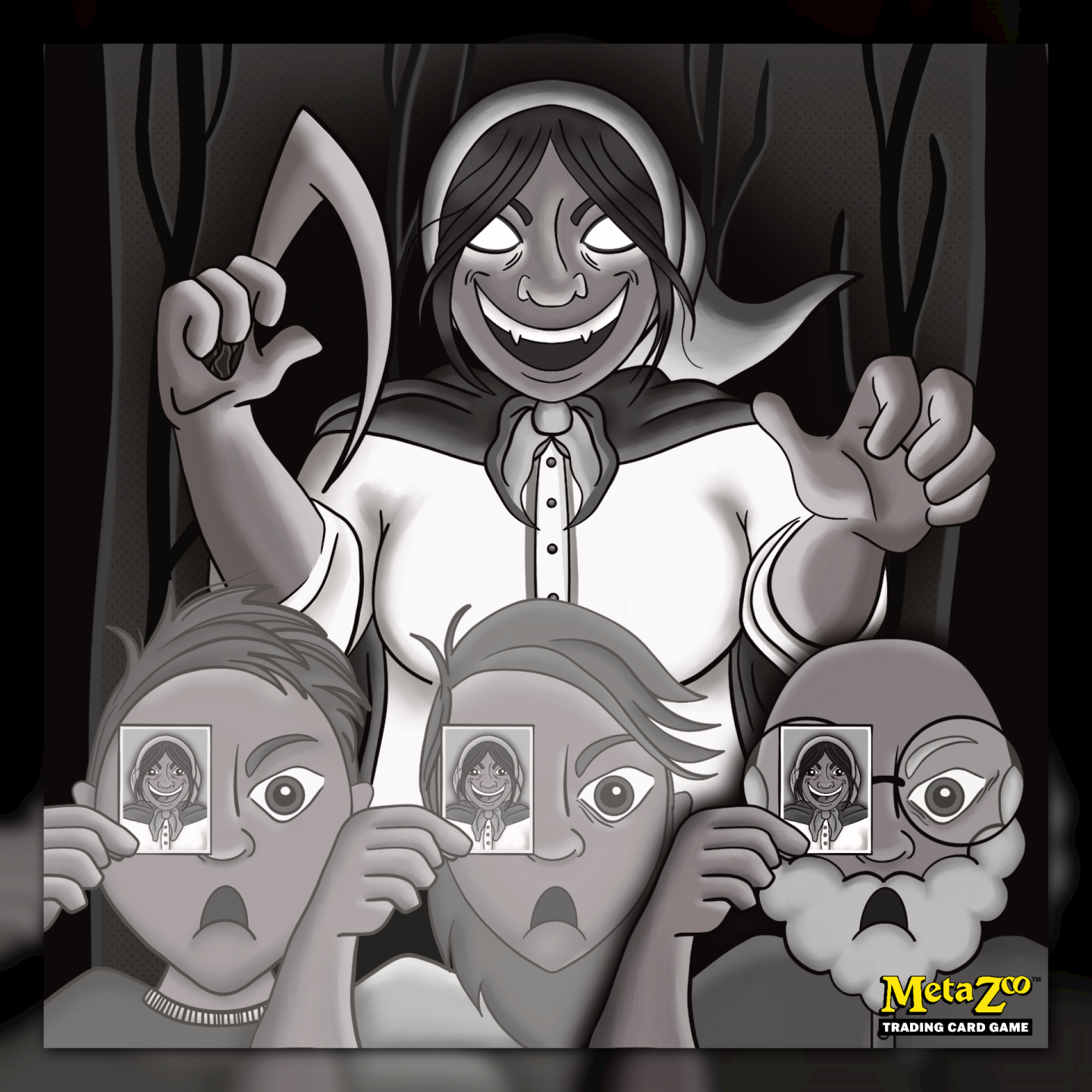
The young one, he’s not ready for me, I don’t think. He stands there under the sun with his hair greasy, his clothes colored like rainbows, his moccasins made by a machine, and his eyes wide. Such a child. He’s unknown to me, so I decide that’s enough for me to drive my black finger into his side and pull out his liver. I will eat it in front of him. But then I discover that he is ready for me. He says, “Spearfinger, you are with me now.” And I can feel that this is so. We share something, a bond, not one I chose but one he wanted. He shows me a card with my picture on it.
“I am a caster,” he says. “I have mapped you.”
Meaningless. I look around at the others in their little children’s circle, holding hands, flowers tucked behind their ears, chanting about love, not war. They are all so young, so naïve. I feel a hot burning to devour their livers, so full of their lives, but then I understand, as if struck by lightning, that they all can see me. The boy—I know his name is Oliver, though he’s not spoken it to me even once—cringes nearby.
“I have not granted this!” I scream. “I am not to be displayed like an animal in a trap!”
The boy, Oliver, tries to calm me. I do not want to be calm—I want to rage and devour and then laugh while they slowly suffer—yet I cannot help but be calmed when he speaks to me. I want to watch his eyes turn yellow and his skin go golden as his body discovers what I’ve taken from inside it, but that enraged desire sets with his words.
“I respect you, U’tlun’ta,” he says, using the name the Cherokee call me. He is not of the tribe, but he knows me too well. “I promised Ahyoka.”
He points to a girl in the circle who is smiling, weaving, her hair black as a starless night but shiny in the bright sun. She is of the tribe. I can feel the beat of her heart from where I hover. There is music from many places around us, but I don’t think she hears it. She looks at Oliver instead of me.
“Did he promise you to me, unega?” I ask.
She doesn’t answer, which I don’t mind. I raise my hidden hand, and when she first sees my long, slender, black finger with its sharp point, her eyes go dim as if she’s gone to another world. But her fool’s smile stays. I will do it quick.
“Not now, Spearfinger,” Oliver says, “not that.”
And as I whirl to take his liver instead, the light blinks away so very fast, and all is blackness and silence again. He and the girl and the singers and the sun, they are all gone. I am alone. So, I just watch that tiny dot of light and wait.
***
The light expands again, and again, I am suddenly out of the darkness and into the light.
It is not where I was before, but what fun! There are warriors everywhere, charging one another, attacking, knocking each other down. It’s dusk, the air is dry, and we are on sand. There are rocky canyon walls nearby. I see a haggard creature in a tophat, and a large bird on fire, and a tall hairy beast with great fists that batter aside a sheep-man thing, and then a winged lizard. All around, the warriors are in foppish attire, holding open books and cards at arm’s length, watching these conflicts unfold. I think it is likely, even, that they are more than watching—I think they are controlling the fights. There must be a dozen of them, half of them wearing purple hats.
I look behind me, and there stands Oliver. But he is like Oliver’s father—he is so much older than the boy he was the last time I saw him. And it was just a few minutes ago. Still, something inside me feels wrong when I think this. I cannot stop staring at the lines on his face and the gray strands in his hair.
“U’tlun’ta.” His voice is deeper, richer, and wearier than when I just heard him minutes ago in the city sun with the singers in a circle and the native Cherokee girl. I look around, but I see none of them.
“Ahyoka?” I demand. I thought she was to be mine.
Oliver looks confused. Then, his eyes grow young again. “Oh, right. We broke up in 1970. She married a marine biologist about ten years later.”
I don’t understand his words, but it doesn’t seem to matter. He comes to himself again just as a man with a cape leaps toward us as if in defiance of the air. Oliver points. “Spearfinger, stop him.”
I feel his urgency in my bones, and I joyfully let it flow into me. The man bounces over my head, and when he comes down again behind me, my finger is ready for him. I turn, graceful as a dancer, and drive my finger’s spear into the back of his neck, pulling it out just as smoothly to aim a second time, this one for his torso, between his ribs, where his liver lies waiting to be pierced.
I squeal, he squeals, and he disappears like fragments of air while I stand watching him go.
“Enough tricks!” I scream, turning toward Oliver. “Give me what I want!”
He points at a creature of metal, a man in armor. “Him. You can have his liver.”
Gleefully, I sprint to the metal man—unlike Oliver, I’m not so old. It’s just how I look. I hit the metal man with a clang and drive my spear finger home. But it’s a lie. He’s not a man. There is no liver inside that human form. When I discover this deception, I stab him with my sharp finger again and again. Stab. Stab. Stab. Like the bouncing man, the metal man vanishes into dusty particles before me. I turn to face the older Oliver again, and he can see my rage. He is not the boy I knew just minutes ago; I can sense the man he has suddenly become, and he shocks me because I can feel he is good.
“Spearfinger,” he suddenly shouts across the short distance, looking over my head in horror, “come back to me.”
I look up in time to see a dragon-like monster, its breath afire, falling out of the sky toward me. It will crush me or burn me in just a few heartbeats. I point my finger up for it to fall on, to do it as much harm as I might before it destroys me. Stupid lizard.
Then the light that brought me to this fight is the light that disappears into blackness again, taking me with it.
***
So comes the dot again. So comes the light.
I have hardly caught my breath from the fight, so I am truly not ready to fight again. But the minutes I had to rest will have to be enough. I raise my finger to stab the lizard as the light bursts around me and then dims.
There is no dragon-lizard, and the lights above me are not the sun. They are not even natural. They are in the roof and encased in material that holds them in place. They hum like insects.
The chamber stinks. I wrinkle my nose as I turn to take in the metal and the silver. There are tubes and wires and things that seem to breathe, though they are not alive. There is a bed, and in the bed is Oliver. It is worse than before—now he has aged so that he looks like Oliver’s grandfather. He is weary and faded like a picture that has been in the sun too long. We are alone, and the sensation I feel in my blood says we will stay that way forever.
“U’tlun’ta.” His voice is weak, stripped of its power. I do not know who has done this to him, but their magic is very strong.
“Oliver,” I say. It is the first time I have said his name, though we have spent less than a meal’s time together. Still, it cheers him.
“I owe you a liver,” he says, the way one speaks when returning a borrowed thing at the end of a long road—something no longer needed.
“You lied about the metal man.” I look around again. “Where is he now?”
“The original is in Alabama.” He struggles to breathe. “The one you hit was shattered. He’s gone. But maybe the caster mapped him again later, I don’t know. It’s been years.”
I refuse to be confused. “Who won?”
“We did.”
The answer means nothing to me, yet I am glad for him. He senses my satisfaction, and he sighs. His lips look dry to me when he speaks again. “You can have my liver now, Spearfinger.”
“No,” I say. But I do not like how I sound: as if I care. “It is old and useless. It will taste like uncooked fish even a starving bear would not touch.”
He smiles. I see the world of much counting around the edges of a turtle’s shell in his smile, in his eyes. “You will like it just the same.”
“No,” I say again.
He breathes again, shallow and failing. “Come,” he says, “because I am already going.”
I shudder as I come to him. He is in pain—I see it. He sees me see it. He smiles like he loves this old woman who does bad things to good people, her long black spear of a finger taking lives it doesn’t deserve. His smile says it is all forgiven because it wasn’t me. I could feel the slow unspooling of his essence in my blood. I am mapped. I am not the original; I have done no harm. And I do care.
“Please,” Oliver says, not asking me to end him, only to not turn away.
The wound I cause is small; it is not a wound meant to stop a heart. That work has already been done by time. I extract with the care of a doctor. He shudders as I did when I approached, and even as I bring his slick liver to my lips, his color is changing. He was already close to the end. I taste—and it tastes as I imagine my own liver tastes. I taste his warm essence mixed with mine.
“U’tlun’ta,” he says again.
“Donadagohvi, unega,” I say, but it is all wrong. He has not been a child, an unega, for many minutes. And “until we meet again”? I do not think we will.
It tastes good.
As I watch him, he fades. So does the light. The blackness is almost complete for me as I go back to where I will wait until