
From the Archives
25: Sak, or “Tombs in the Desert”
We make some decisions, we casters, that sometimes impact a life but sometimes a lifetime, our own or another’s. When this manuscript came to me through a trusted associate in Cairo, he did not reveal the author’s name to me nor even provide me with a hint that would help me draft the postscript. Just the same, he emphasized to me the importance of the document’s words: “Sak remains in the desert, and she watches what we do. She has already watched for many lifetimes. The watching may soon end.”
I have no hope for an ending or a continuation. Like Sak, sometimes I just watch.
Only 977 tales to go.
I have never cared for the word seer. It makes the gift of vision sound clean, holy—like a window wiped clean of fingerprints. Mine was never a window. Mine was an old bruise, a sensitivity that refused to fade, even when I begged it to. I could walk through a bustling marketplace and feel the outlines of things no one else could perceive—cryptids that moved like rumors, leaving only a pressure behind the eyes, a faint taste of metal on the tongue, a prickle along the forearms.
Most men go through life attended by nothing but their own thoughts. I went through mine with constant company.
The first time I saw a cryptid clearly, I was a boy with my nose pressed to a rain-streaked pane in Surrey. A fox looked up from the hedge, and for one perfect second, it wore a face that was not a fox’s at all: too old, too knowing, as though it had been watching me watch it for centuries. I dropped the curtain. When I dared to look again, it was only a fox, and the hedge was only a hedge. But my body remembered the shock the way skin remembers a burn.
Later came the craft: mapping. The copying of essence—not the creature itself, not its whole truth but the smallest sliver that could be taken without stirring either of us. A caster can read the cryptid the way a musician reads a score. We can coax a motif from it, press it into a prepared medium, and bind it to a card the way a photograph binds light.
I learned to do it properly in Cairo, among men who liked to call themselves rational—the British Museum’s agents, the collectors, the polite robbers of tombs. They spoke with confidence about strata and dynasties and provenance. They spoke as though the past were a ledger—something to be balanced, filed, and stamped.
Meanwhile, the desert breathed.
In the years before Howard Carter’s triumph, the Valley of the Kings was a map of disappointments. Men had been digging there for generations, lifting shards and broken beads and the occasional painted fragment, and announcing each small recovery like a conquest. I watched them congratulate one another over meaningless dust. And I watched something else.
At dusk, when the limestone cliffs cooled and the sand gave up the heat it had hoarded all day, the valley would change. Shadows pooled in seams that looked too deep. The air thickened, faintly perfumed—lotus and iron. The workers would shrug and wrap their scarves tighter. The foremen would curse the “Valley wind.” Carter would roll his cigarettes with that quick, fussy pride of his and insist on one more survey line, one more trench.
And I would feel her.
Sak did not announce herself with trumpets; a cryptid like her does not need to. She was more like a pressure under the skin of the world—a guardian, yes, but not the kind painted on children’s charms. Sak was what remained when fear was finally allowed to mature into duty.
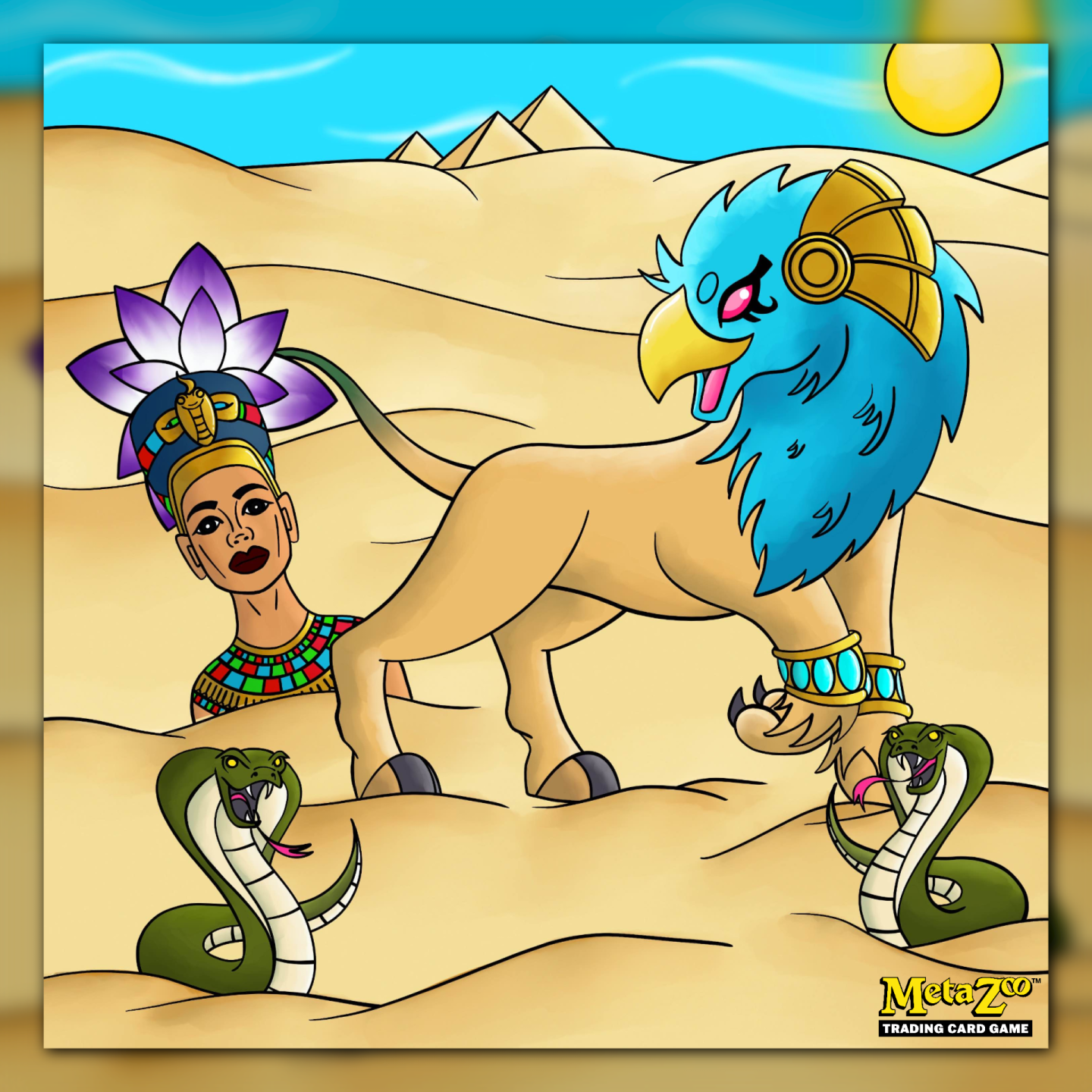
I had read about her in scraps—half-legends in travel journals, margin notes in a antiquarian’s book, a singed page that claimed to be copied from “a temple text,” one that no serious scholar would have dignified with a citation. In those so-called documents, Sak was described as a chimera: hawk-headed, lion-bodied, horse-hinded, with a lotus in full bloom where a tail should have been. Always female. Always hungry. Always near the royal dead.
Scholars laughed at such things. They called them superstition. But the desert, the one that breathed, did not laugh.
I first saw Sak properly on a moonless night, when Carter’s camp had quieted and the valley lay like a land asleep. I went out alone, as I often did, with my satchel, my chalk, my spellbook wrapped in oilcloth with my few blank cards inside. The air tasted like stone.
At the base of a cliff, where rubble had been piled by a dozen previous excavations, a shadow moved against the shadows. I felt her before I saw her, the way you feel a thunderstorm before you’ve felt the first raindrop.
Then she stepped forward.
Her head—hawk, yes, sharp as a blade, with eyes that held the low, ember-red patience of predators. Her body—lion, muscled and magnificent, scarred in places as though she had been cut by more than claws. Her hindquarters—horse-like, heavy with power. And behind her, unfurling with slow contempt for physics, a lotus-tail opened petal by petal, luminous in the dark as if it drank moonlight that I couldn’t see.
She did not roar. She did not hiss. She only watched me, and in that watching was the question that guardians always ask:
What are you willing to pay?
I did not step back. How could I? My heart was a drumbeat in my throat, but my hands were steady. A caster’s courage is not bravery—it is compulsion dressed as poise.
“Sak,” I said softly, in a tongue that was half Arabic and half the old phrases my teacher had insisted were “older than grammar.” Names matter. Names are power. And hers fit the shape of my mouth as though it had been waiting there my whole life.
Her lotus-tail stirred. The petals gave off a scent so rich it made my eyes water.
I carefully opened my satchel and drew out a blank card from my spellbook.
A proper card is not mere paper. It is impossible to describe to someone who has never had cause or skill to wield it, but I will try. It is layered rag-stock infused with gum arabic and powdered lapis, pressed thin, dried under weights, then sealed with a varnish that catches certain kinds of essence the way silver catches moonlight. The face of the card is plain until the mapping takes—then it becomes an image, a sigil, a texture you can feel even with your eyes closed.
I held the card up between us like a small, polite shield.
Sak’s gaze shifted to it, and for an instant I saw something in her that looked like amusement, the way that thunderstorm I spoke of might be amused by an umbrella.
I began to map her.
The trick, I suppose one might argue, is never to take too much. In fact, you do not actually take from a cryptid—you invite it to leave a trace. You offer a corridor through a mapping gate and let the essence decide whether to step through. You make yourself porous. You let your senses bloom and ache and then you hold, you hold, you hold—
The air thickened around me. My ears rang. The world narrowed to an invisible line between my chest and Sak’s eyes. Her scent flooded me—lotus, blood, sunbaked fur. My hands trembled now, not from fear but from the pressure of proximity to something older than my country.
Sak exhaled.
Her breath was warm and smelled of tomb dust. It rolled over me and my card like a fog, and the paper drank it.
There was a moment—it’s always a moment, one that is unavoidable—when the card feels like it might ignite. The edges seemed to grow hot and the center, cold. My teeth hurt. I bit down so I wouldn’t cry out and alarm her into leaving.
Then our essences caught and blended, inseparable like a drop of blood in a cup of water.
A shimmer moved across the blank face of my card. The outline of a hawk’s head appeared in faint metallic ink. Beneath it, the suggestion of lion musculature, the sweep of horse haunches, the bloom of a lotus. A sigil formed in the corner—three strokes and a curl that meant guardian in a script no one teaches anymore.
I lowered the card, gasping.
Sak’s eyes did not leave me.
I had what I came for. I should have backed away. I should have bowed and retreated like a sensible thief who has stolen his treasure and wants to keep his hands. I should have been an archaeologist reveling in his find, taken uninvited from the sand.
Instead, I said, “You guard something.”
Her lotus-tail snapped once with great impatience.
I let my mind settle into that strange half-hearing that some casters develop: not thoughts exactly but impressions that arrive with the certainty of a remembered scent.
Behind Sak, in the cliff face, the rubble felt wrong. Not merely piled but arranged. Not merely collapsed but hidden. The valley around us seemed to tilt, as if pointing.
I laughed, very softly, because the revelation was both obvious and absurd.
All those men. All that money. All those trenches.
And the guardian had been standing on the secret like a cat waiting outside a mousehole.
***
The next morning, I went to Carter.
He was in his tent, hunched over notes and sketches, his moustache bristling as he muttered at a list of expenses. Lord Carnarvon’s patience, I knew, was fraying. The project was bleeding funds like a severed artery. Carter’s pride was a thing you could taste in the air: sharp, acidic, close to panic.
He looked up as I entered, eyes narrowing as if my presence were an inconvenience he could not bill to anyone.
“What is it?” he said. “If you’re here about wages, speak to Callender.”
“I’m here about the tomb,” I replied.
His pen paused.
“Oh?” he said. “Which tomb is that? We have half the valley’s worth of theories at this point.”
I placed my satchel on his table and reached into my spellbook. I took out the Sak card and set it down between his maps and his ashtray.
He stared at it. He did not see what I saw—he could not perceive the residual shimmer along its edges, the faint warmth like a living pulse—but he did see the image, because the card, once mapped, shows something to anyone with eyes.
“What is that?” he asked with the irritation of a man confronted by another man’s hobby.
“A guardian,” I said. “It stands watch over a buried entrance—here.”
I pointed, not to one of his current trenches, but to a patch of ground he had marked and dismissed weeks earlier. A place cluttered by spoil heaps and the remnants of old work. A place too messy to look promising and therefore ignored.
Carter leaned back.
For a heartbeat, I thought I saw interest in him, the flash of a gambler noticing a tell. Then his face tightened.
“And you know this how?” he said.
“I followed her,” I answered. “Sak.”
“Listen,” he said, his mouth twisting, his voice dropping into a tone men use when they wish to sound reasonable while being cruel. “I don’t need… this.”
He waved one hand toward the card as though shooing a fly.
“I have intuition,” he went on. “I know where to dig. I’ve known for years. I’m here because I know. I don’t need help from—”
He looked me up and down, taking in my dusty boots, my too-quiet manner, my refusal to flatter him.
“—from some amateur mystic.”
I resisted the insult.
“I’m not asking for credit,” I said, though even as I said it, I knew it was a lie. Credit is a kind of oxygen—deny a man enough of it, and he begins to suffocate. “I’m telling you where the entrance is.”
Carter stood abruptly, knocking his chair back.
“You will not interfere with my work,” he said. “If you have fantasies, keep them to yourself. I am not funding a circus.”
His face was red now, his pride flaring. In that moment he looked less like a great discoverer and more like a boy furious that someone else might know his secret.
“I will find it,” he said, jabbing a finger at his own chest. “And when I do, it will be because I followed my own instincts, not because I listened to—”
He cut himself off, but the contempt was clear enough.
I gathered up my book in silence. I bowed slightly—not to him, but to the necessity of leaving before my temper did something irreparable.
Outside, the valley was bright, indifferent. The workmen hauled away baskets of sand. The cliffs watched.
But that afternoon, Carter ordered a trench cut precisely where I had indicated.
Of course he did; he could not afford not to.
When the first step emerged beneath the debris, he called it luck. When the second step appeared, he called it perseverance. When the sealed doorway revealed itself at last, he called it destiny.
And in the photographs, in the newspaper accounts, in the breathless dispatches to London, my name did not appear at all. Not even as a footnote. Not even as a rumor.
Carter stood in the mouth of history and shouted his own name into it until the echo returned as applause.
I read the papers by lamplight and felt my chest fill with something heavy and black. Not grief, exactly. Not rage, either. Indignation, I decided—pride’s cousin but far colder. And that was when I decided the world deserved a curse. Not because I believed in the old pharaohs’ vengeance—not really. But because stories are spells, and men who dismiss mysteries deserve to be frightened by them. If I could not be written into the narrative as a guide, I would write myself in as a shadow.
So, I began small.
A workman stumbled on a stair and broke his ankle. “Bad luck,” Carter said, irritated more by the delay than the injury. I whispered a phrase into the wind and touched my Sak card with my palm, letting the mapped essence of the guardian’s presence drift onto the breeze it brought. The camp’s lanterns flickered. The donkeys brayed. Someone swore they saw a hawk-headed thing perched on a spoil heap, watching with angry eyes.
Rumors are like dry grass. They only need a spark to destroy it all.
When Lord Carnarvon later fell ill after a mosquito bite that became infected, I did not cause it, of course—fate does not require my assistance for such ordinary tragedies—but I framed it. I planted a phrase here, a suggestion there. I encouraged the press’s appetite for the dramatic. I let the word curse slide from tongue to tongue like a sweet.
Soon, the tomb was not merely a tomb. It was a trap. It was a warning. It was an insult hurled from the ancient past into the modern world.
Carter hated it. I know, because I saw his face when a journalist asked him about it. His eyes flashed, and for a second, I thought he might strike the man. Carter did not like forces he could not measure with tape or justify in a ledger. He did not like anything that implied the valley was not his. And that pleased me more than it should have.
In the months after the discovery, I returned to Sak. Not my card—the real guardian.
She was there, as she had always been, though the valley around Tutankhamun’s tomb now crawled with people and greed. Guardians, I determined that day, are patient. A cryptid does not abandon its post simply because humans have begun to swarm it.
I approached her at dusk, when the tourists and officials had retreated and the cliffs had cooled.
Sak stepped from shadow into shadow, her lotus-tail opening and closing as if it were breathing on its own.
“You did your duty,” I told her, my voice low, “yet they called it intuition.”
Her eyes fixed on mine, unreadable.
“You guard more than one,” I said; it was not a question but rather an assumption.
The impression that came back was not words but a direction. A weight in the air. A second hidden seam in the world, deeper and more carefully disguised.
A queen, my bones understood.
Nefertiti.
The name landed in my mind like a discovered jewel dropped into a bowl for assessment. Beautiful. Cold. She who might have been a pharaoh, one that time had hidden from humanity and that, like the greedy children they were, archaeologists were certain was the next big “find.” Her legend was great before the Boy King’s name was even known.
I saw—no, I felt—a tomb not yet violated by spades and flashbulbs, a place sealed so tightly that even the desert had forgotten the taste of its buried air. Nefertiti lay untouched by the hands or the eyes of Westerners. I knew this was still true.
And with that knowledge came temptation.
If I had led Carter to Tutankhamun and been rewarded with dismissal, what would I do with Nefertiti?
At first, I thought: I will find it myself. I will claim it. I will force the world to write my name.
But I was British, and I had been raised on a steady diet of propriety. Also, I had seen what discovery did to men like Carter. It did not make them noble; it made them hungrier.
So I did something more subtle. I became a misdirection.
Years passed. Decades.
Archaeologists came and went. Methods improved. The valley changed. New names rose and fell. Egypt itself shook off the old colonial grip and began, rightly, to claim its own past with a certain fierceness.
Through it all, I stayed—sometimes in person, sometimes through proxies, sometimes through whispers that traveled faster than I could.
When a promising survey began near the seam I had felt, an “unfortunate” collapse discouraged further digging. When a new team grew interested in a particular wadi, a rumor of unstable rock sent them elsewhere. When a scholar presented a compelling argument for Nefertiti’s burial in one location, I quietly amplified a counter-theory until debate drowned certainty.
I did not need grand magic. I did not need lightning. All I needed was to keep human attention aimed in the wrong direction.
For all my actions, Sak just watched.
She never interfered with my interference. I suspect she found it amusing, though I cannot claim to know if she truly possessed a sense of humor.
Sometimes, when I was alone in my rooms, I would take out my Sak card and run my thumb along its edge, imagining I could feel the faint pulse of her mapped essence. In my eyes, the guardian’s image had darkened with age; the lotus tail seemed to shimmer less brightly now, as if the card itself were tired.
I understood that feeling.
Spite is a fuel, but it burns dirty. It blackens the walls of your own mind. It ultimately exhausts your resources.
In my youth, I had believed my anger would keep me sharp forever. In my later years, however, I realized anger is not immortality. It is simply another kind of decay.
I began to dream of Carter—not as the triumphant figure in photographs, as the world knew him, but as the man in his tent, snapping at me like a cornered dog, insisting on intuition as though it were a divine right.
In the dream, I would shout my name at him. But in the dream, he never turned.
One winter, when my hands had begun to tremble even without magic, I returned to the valley for what I knew, deep down, would be the last time.
Sak was there, waiting for me.
Her hawk eyes were unchanged. Her lion body still carried the same immense authority. But the lotus-tail—the petals seemed to glow with a gentler light now, less cruel. Or perhaps it was only my own exhaustion that softened her in my eyes.
I stood before her and did not raise another card. I did not ask for essence. I had already taken enough, years earlier.
“I have kept them away,” I told her. “For years.”
Her gaze did not flicker.
“I did it because I was slighted, because a man dismissed me and called his theft of my guidance ‘intuition.’ Because the world applauded him and forgot the hand that pointed.”
The valley wind stirred my coat. Sand hissed against stone.
“I am tired,” I admitted, “and I am not proud of the shape my bitterness has taken.”
Sak’s lotus-tail opened a fraction more, scenting the air with sweetness so rich it almost hurt.
I swallowed.
“I ask a favor of you,” I said, and my voice cracked on the word. “Guard the queen’s tomb. Keep it hidden. But—”
I took a breath. This was the hinge of it, the turning point between spite and whatever came after.
“But never reveal it,” I said, “except to one who shines with intuition. One who would have found it even without you.”
For the first time, Sak moved as if she understood the poetry of my cruelty. Her hawk head tilted. Her eyes narrowed with something like calculation. A faint impression returned: the feel of a smile without a mouth.
Yes.
Yes, she agreed.
I laughed then—not because it was funny but because it was final. My last curse was not a bolt of misfortune but a rule designed to mock the very man who had wounded me.
Intuition.
Shining intuition.
As if such a thing were real.
I left the valley with sand in my shoes and a strange lightness in my chest. I had made my peace with Sak, if not with myself.
Now, as I write this, I am an old man. My hands ache. My eyes blur. The world is full of new voices, new politics, new treasures fought over and repatriated and argued about. Carter is long dead. Lord Carnarvon, too. Tutankhamun’s gold has toured the world like a celebrity’s wardrobe.
And my name?
My name has never been printed beside theirs.
So I print it myself, here, at the end.
My name is Sinclair. Remember it, even if it fades.
Consider this my final curse on the memory of Howard Carter and his king: I die knowing there is no such thing as shining intuition—only work, and luck, and the hidden hand that points.
And yet—
And yet I have bound Sak to my ending wish.
Let the guardian wait for a man who “shines.”
Let her wait forever.
Postscript
Recent reporting has quoted Dr. Zahi Hawass—the prominent Egyptologist and former Minister of Tourism and Antiquities—speaking publicly about the prospect of finding Queen Nefertiti’s tomb, suggesting he believes the search may be narrowing toward a breakthrough.
I knew Sinclair many years ago, and his grandson has been in my sphere of awareness as well. We never discussed Sak; I was unaware of his obsession until his manuscript came into my hands. Nevertheless, the coincidence that closes his document is linguistic and therefore verifiable:
- Zahi (زاهي) is commonly glossed as meaning “bright,” “shining,” or “radiant.”
- Hawass / ḥawāss (حواس) is a common Arabic word for “the senses” (as in “the five senses”).
When these two names are brought together—shining + senses—I believe it is close enough to Sinclair’s “shining sensitivity” that one understands why he ended with it. The desert itself must have a taste for irony.
If Sinclair’s final “curse” holds—if Sak reveals the queen’s tomb only to one who “shines with intuition”—then, by the simple accident of a name, the guardian may soon fulfill a dying Englishman’s spiteful wish. As with so many tales, I will continue to monitor its progress until, like Sinclair before me, I can monitor no more. —Abraham Macamaran