
Chapter 13
In the Mountain with Madness
“You act as if you’ve never seen a limbless man carried in a papoose by a yeti before,” he said.
For the longest time, I didn’t know what to say. The albino giant who had brought me here stood by as rigid as a statue carved of quartz, staring at some distant space between Blake and me. My mind was flooded with images and questions, theories and suppositions about Agnes and the German caster Erik Ackler pursuing her, and Dracula’s stolen spellbook, and Elena Popa held prisoner by the vampire until that book was returned. I remembered the tentacles that rose from the Bòcan Pavilions as Blake prepared to destroy the Caster Enigma Coalition, the casters with purple berets who were bent on his silence. The tentacles that dragged a German bomber down from the skies above, leading him to find Blake’s spellbook in the destructive aftermath, a book that contained the horror Blake the Black had used to obliterate his enemies, a horror the Germans now believed could help them win the war in Europe. All this chaos and madness now centered on a cave in the Himalayan Mountains, far from where it began, far from where anyone would ever think to go. I swallowed hard, my mind alive, and I prepared to put it all into words that would unlock this inexplicable and mysterious trajectory I’d pursued.
“You have no eyebrows,” I said.
“And thus do we begin our intellectual exchange,” Blake said. The yeti carrying him sat down, crossing its legs. Blake rested like a doll in his lap.
“Or ears.”
“Witticisms abound.”
I tried to refocus. “All right, then. How is it that you’re not dead?”
“I’ll do you one better. How is it,” he suddenly snarled, his face contorting and his chest heaving, “that you and Whitnail never bothered to find out if I was?”
“I don’t know—you reckon it might’ve been the bombs, Blake?” I shouted back. “Or the giant octopus monster, or the crazy casters who came to kill you, or the fact that you killed Chansey right there on stage in front of God and everyone? Any two of those were enough to make me want to leave skid marks getting away from you.”
Blake’s right shoulder twitched—if he’d had an arm, he would have raised it and held a finger up, I was sure. “I had nothing to do with the bombs.”
“You killed Mingma,” I said, and when he looked confused, I added, “My guide, the sherpa. And Mohandas.”
“Oh. I’m sorry about the sherpa. These yeti, they’re fairly feral. But the Indian bloke isn’t dead—I had one of the abhibhaavak take him down to Kathmandu.”
“What’s a—?”
“It’s the Nepali word for ‘guardian.’ Whitnail’s people. They watch over the yeti.” Blake paused, seemed to consider, and then the yeti carrying him gently scratched his nose for him. “And where’s Whitnail? That’s why I’m here, you know—to find another Whitnail. You took mine. But why are you here? And let me ask again: Do you know where my spellbook might have gone, my boy?”
I knew the answer about his book, but I still didn’t really know much of anything at all. As for Whitnail, I felt a strong need to protect him. “Whitnail stayed in London to look for you. I’ve not seen him in months. And I didn’t ‘take your’ Whitnail—he’s not a possession, Blake, and if he were, I wouldn’t say he’s ‘yours.’ As for your spellbook, a German pilot bailed out over London during the bombing and found it. He was sneaking it back to Germany, I guess, when he was captured by French students in Paris, and they took it. That’s the last place I know it was.”
Blake made a disgusted noise. “The French. Never mind the Auld Alliance—those cowards will treat it the same way they do guns: never use it and surrender it first chance they get. It’s probably in Berlin by now.”
“Even if it is, the Nazis can’t use it.” I gestured to the black stone around his neck. “Don’t they need that?”
“No.” Now Blake looked at me with renewed suspicion. “Any of my kin with their own spellbook will do. So, tell me, nephew o’ mine, why I found you on a mountainside in the Himalayas. Were you hunting me perhaps?”
“Hunting you? If I’d been hunting you, I’da doon it in London on my ’ands and knees with a magnifying glass.” I swallowed my traces of accent. “I thought you’d been blown to jam. I’m looking for my sister, Agnes, not you.”
Blake scowled. “What would Agnes be doing in Nepal?”
“Dracula sent her from Romania to recover his spellbook from you.”
“He did, did he? And you’re, what? Her second, in case she fails?”
“I’d say that’s close enough.”
“Well, this is a bit awkward, then.” Blake met my eye. “It seems that our vagabond vampire Vlad has played both ends against the middle here. He’s correct that I took his book—but only because he betrayed my trust and needs to make it right. But now Agnes is in the game as well, thanks to that anthropomorphic leech. Messy. As the saying goes, ‘Oh, how we weave a tangled web—’”
“Actually, it’s ‘Oh what a tangled web we weave when first we practice to deceive,’” I said. “It’s by Sir Walter Scott from a poem—”
“No, no, you need to stop now, professor. I’d put my hands over my ears if I had either of those.”
“Fine. Instead, I want to note that I’m amazed you used the words ‘vampire’ and ‘trust’ in the same sentence.”
Blake winced. “Cutting but true.”
“How did he betray you?”
Despite his lack of hands, Blake tried to handwave my question away. “That’s more academic than material. The point is—”
“No, Blake, listen to me. Someone’s life hangs in the balance here. I know it’s hard to believe, but someone who’s more important than you. I need Dracula’s spellbook. I need to take it back to him. Tell me how he betrayed you so I know what I’m getting into.”
“It’s a girl, isn’t it?”
“As you said, more academic than—”
Blake laughed. “Did you wine and dine her but end up broke? ‘He had no means to pay the debt, so Romie owed what Julie et.’ You want to trade Vlad back his spellbook for your sweetheart, right? Presumably before she becomes one of his unblushing brides.”
“Will you give it to me?”
He’d been sounding like a mix of the old Blake and a newer, slightly crazier version, but now his face went humorless and he ground his teeth as he thought. Finally, he said, “You tell me what you’d do here, Arthur. You’re a learned young man. And you’re a well of deep thoughts.
“I hear a bomb falling, that whistling sound they make from a high note to a low note to a boom note. I am scattered to the four winds, as it were, but I am not dead when I awaken in the various craters that marked London that night. I am in agony. I am in disbelief. But I am still within the realm of my senses, so despite my lack of limbs, I roll around and scream because I can feel my spellbook near.
“Alas, it is not my spellbook—but it is the stone that powers it, and nearby I find a single page with only four cards. Thankfully, one of them is the yeti. I put the stone in my mouth, my forehead to the card, and a few moments later, I have a white-furred extension of my limbs. Then I use a second card, an aitvaras. I don’t believe I ever trained you on that one, did I? It’s a Lithuanian chicken. Very loyal to the household of the farmer it chooses. And the aitvaras leaves a trail of sparks because its tail is made of flames. So, I use chicken butt to cauterize where my limbs used to go.
“With another of my cards, the piasa bird—which can fly, if you don’t know—I catch the first flight out of jolly ol’ England, which may well be bombed back to the Stonehenge age by now, for all I know.”
He paused and waited, but I didn’t say anything. He continued.
“In proverbial leaps and bounds, I make my way across Europe, and the challenges are worthy of literature, my boy. You could write a book worthy of Jack London.” He grinned, and when I didn’t respond to the name, he snorted. “Philistine.”
I was about to protest when he went on. “Years ago, I tracked down Vlad the Impaler. He was in one of his nobleman phases at the time, and at first, I had just planned to map him—and then drive a stake through his heart. There are some cryptids best kept to oneself, you see. But when he’s not a wild animal, he’s quite the conversationalist. We got on splendidly. And I saw in him a potential for partnership that I’d not seen in other cryptids—beneath his count façade, I could see a monster that might serve as the most violent guard dog for a treasure I had been carrying with me but was anxious about losing: I had a second spellbook to hide.
“It had no stone—I use just the one you see here around my neck—but I’d filled it with enough cards that should anything ever happen to my primary book, I could at least begin again. And leaving the rubble of London with just one page of my old book, I clearly needed another.
“From London, I make my way by hook and by crook to Romania. It’s time to visit Vlad, congratulate him on his latest host of undead brides, apologize for not RSVPing to any of the weddings, and recover my spare spellbook. Unfortunately, at the time I arrive, he is in his savage state. Filthy, demented, practically unapproachable. In that mindset, he would bite the hand that feeds him, even if it were his own hand. Just the same, I had spared him years earlier in exchange for him keeping my spellbook safe, and by the heavens, I intended to recover it.
“But I might just as well have asked Little Orphan Annie to guard it for me. When he isn’t snarling or twisting like a contortionist from the Bòcan Pavilions, he tells me in fits and starts that a German caster had found his way to Poenari Castle and had absconded with my spare spellbook.”
I almost groaned. No doubt there were many other male German casters in the world, but I knew that Erik Ackler was searching for either Blake’s spellbook or members of the MacCamran-Loughty family line–or both. I started to speak, but Blake was already moving ahead with his tale. He’d not changed in that regard: He had always enjoyed the sound of his own narrations.
“This is intolerable, and I tell Vlad as much. But he is dismissive and shameless, so I alter the conditions of our agreement: I help myself to his own spellbook. And even as the spittle flies from his mouth and he bleeds from the eyes, I make it clear to him that it will remain in my possession until such a time as he finds the German bandit and retrieves the book he was supposed to be guarding for me. I’m certainly in no condition to go traipsing around battlefields looking for it.
“And so now you’re here with me. You say you’re looking for your sister, Agnes, but you also zero in on Vlad the Impatient’s spellbook, because both she and you want to take it back to him—you to trade for a bonny lass he’s holding, Agnes for whatever her own reasons are.
“And here we come to where those paths in the woods diverge—no, don’t correct it for me, I don’t care that much. So, the question is: If you were Merlin, would you give young Arthur Vlad’s book?”
I looked at the cave’s rough ceiling, the single fire nearby flickering and sending shadows skip-hopping across the rock. I looked over at the abhibhaavak—I remembered it as “Nepali for guardian”—but her eyes were focused straight ahead on nothing. Her existence alone made me miss Whitnail the way I imagined Blake might miss his legs.
“I would,” I finally said.
“Consider me clapping with astonishment,” Blake said, grinning. “Tell me why.”
“Because this is your mess. You weren’t content to hide from those purple berets or even to just fight them. Instead, you decided to obliterate them. You called up that tentacled monstrosity—”
“Cthulhu. Fewer syllables.”
“—and that made you a target for the German bombers. You sacrificed the entire Bòcan Pavilions so you could go after the Caster Enigma Coalition. And for what? They just wanted you to stop showing off cryptids. You couldn’t do that?”
“It was always bigger than that.” Blake seemed to contemplate whether or not to expand on this, then simply said, “Cthulhu is the ultimate Forbidden. They were after me because I mapped the Forbidden.”
If his intention was to distract me—Oh, please, insightful and knowledgeable Blake the Black, I’ve crossed the oceans and climbed to the mountaintop to hear the secrets of the universe! Bestow your wisdom of the Forbidden upon me now!—he was to be sorely disappointed.
“And when they bombed you and your Forbidden? Did you have the decency to return to atoms? No, instead, you and your stupid spellbook—with this Cachoochoo still in it, I assume?—survive in bits and pieces, and that makes the Germans sit up and take notice.”
Blake winced. “If you’re going to invoke the name of the Forbidden, at least say it the way it’s supposed—”
“Stop talking. Start listening. Now, the Germans think they can conquer the entire planet if they can get their hands on this end-of-time monster that you carry around casually like a bloody cigarette lighter, for all the delicacy and respect you treat it with. And they have a caster in their midst—his name is Erik Ackler. Presumably, he tells them it’s not enough to just have your Cuckoowho card; they need either you or someone in your bloodline to make it work.”
I was getting myself wound up like a pocket watch, but at least I felt I had Blake’s attention, though his mapped yeti seemed to be sleeping.
“So, as long as they’re beating the tar out of Europe in every corner, they start looking for you, your spellbook, and your kinfolk. They catch Elijah and send him to Wewelsburg Castle—that’s the Nazi insane asylum for their High Command—but they don’t have the card yet, so they just keep him around as a prisoner. Meanwhile, Ackler is hunting for Agnes, who took to the road when the Germans overran her village. As it happens, she’s heading for Romania, and Ackler follows her.
“He must have figured out where she was going, and he goes to head her off at Poenari Castle. But here’s a surprise! When Ackler gets there, he finds that you, Blake the Blockhead, have a second spellbook hidden with Dracula, and since that’s exactly what he’s been looking for, he steals it from the vampire and off he goes, probably assuming Elijah is still a prisoner at Wewelsburg Castle, though he’s not—I personally rescued him, ta’ much.
“Then you arrive, get self-righteously foul about an undead vampire king that’s stopped playing librarian for you, and you make off with his spellbook as a childish retaliation. You tell him to get your spellbook back from Ackler. Instead, Agnes shows up next—because Dracula’s castle is apparently the Café de Paris of Eastern Europe with a red velvet rope and maybe a doorman or two. I don’t know what she came for, but Dracula sends her after you for stealing his book instead of going after it himself.
“And in the meantime, you’ve come halfway ’round the planet to Nepal to—what? Replace Whitnail as your man Friday?”
Blake grinned again. “So, you have read Jack London.”
“No. Friday is from Robinson Crusoe by Defoe. Does all of this sound right to you?”
It did not seem that way to me—I felt there were motives missing and pieces of the puzzle I’d not sorted out yet. But I didn’t bother waiting for whatever sarcastic, smarmy answer he was thinking of—I moved straight to my point.
“You’ve sown some bad seeds. It’s time to reap. It was all coming to this. I’m here, Agnes is coming here for Dracula’s spellbook, Ackler is after her because she’s your bloodline—”
“So are you, Abraham,” Blake interrupted. There was clear menace in his voice. “Maybe there are other solutions to this problem. Dracula sent you for me as well, I assume. You’ve made yourself part of the problem, haven’t you?”
“You’re going to hand me over to the Nazis, are you? That’s going to be a tough one, given you have no hands. You’re a doormat, Blake. There’s not enough of you to be taxidermized.”
Blake smiled without humor. “That’s not a word, is it?”
“Let me go. Give me Dracula’s spellbook. Give me back my own spellbook, and I’ll find Agnes and stop Ackler. Then I’ll go after the rest of your spellbook and shatter that tentacled monster card before the Nazis get hold of it. What other choices are there?”
Blake’s yeti opened its eyes and slowly stood up; the two of them towered over me, but I stood my ground. Something unpleasant rumbled in the yeti’s gut. Blake ignored it.
“No,” he said. “That’s not a good plan, my boy. You come to me practically useless. You have a dozen cryptids mapped. A humpledumple? I mapped a Forbidden, you mapped a potato. A god versus a toy. And your story is woefully incomplete. Too many unexplained bits and bobs. It’s not much good to me.”
“Please, Blake.” I tried to remain in control, but it was very, very hard. “Her name is Elena. Dracula killed her mother. She has no one to count on but me.”
Blake’s face sagged, wounded, but he still shook his head. “I’m sorry, Arthur. If I make it back to Romania, I’ll see about trading his spellbook for your girl. But you say your sister is coming here, and she’s leading a German thief right to me. I need to consider what sort of reception to give them.”
His yeti turned to go, and the abhibhaavak took a step toward me. I had one last card to play, as it were, and so I called after his back, “If Ackler has your second spellbook and he catches up with Agnes, she can access your mapped tentacle monster. She can give it to him. You just called it a god—do you want that in the hands of the Nazis?”
The yeti turned so Blake could see me. He smiled tiredly. “That won’t happen. And they won’t find you to do their bidding, either. I’m not handing you over to them.”
I swallowed a rising fury. “You’ve always known so much, haven’t you? But do you know what I’m thinking?”
“I do. But your Indian friend took your sherpa’s rifle with him back to Kathmandu. It isn’t here. So, I’m afraid you won’t be shooting me.”
“I wasn’t thinking that,” I said. But I was.
“Well, just the same—now do you know what I’m thinking?” He didn’t wait for my response, but I could read the madness in his eyes. He stared at me for the shortest of moments, but that madness had no remorse or regret in them. Just a conclusion he had come to.
Either I was never leaving the mountain again—or I was leaving as a corpse.
***
The guardians—the abhibhaavakharu—were not openly threatening, but their presence was an unnerving reminder that I was not free to leave the mountain caverns; in fact, I was not even allowed into many of the corridors that descended deeper into dark zones where no natural light ever went. A guardian was always near, and if I even pivoted toward a corridor where I wasn’t welcome, that guardian would silently but deliberately block my path.
They never spoke, not even when spoken to. I asked the one who’d apparently been assigned to me about Whitnail and if he knew my friend—I didn’t want to presume anything—and he simply stared at me as if he didn’t understand or didn’t care.
With no visibility to the outside world, the yeti caverns began to impact my sleep cycle almost immediately. It was cold all the time, the kind of cold that makes your muscles tighten up and tremble so violently that you can’t otherwise move for long minutes, so I either walked around or I crawled under the pile of furs I was given that smelled foully of the unknown animals they came from. I never encountered any yeti, though I could hear their howls on occasion.
I was directed into an alcove under an outcropping where I could sleep. I crawled into it whenever I felt tired enough, but I didn’t know how often I slept or for how long under the disgusting furs.
Faster.
Dracula whispered in my dreams, his accent thick, his breath hot against my ear, his face nothing but eyes and fangs.
I will make her die here every time if you do not go faster.
What he then showed me is best left undescribed, though I’ve never forgotten it. Elena’s screams were drowned in her own blood, and Dracula sneered at me with her blood on his lips. I woke up screaming and thrashing, striking my head against the rocky ceiling just inches above me. The abhibhaavak reached in and pulled me out of the alcove as if he were pulling a trunk out from beneath a bed.
This happened over and over, every time I tried to sleep.
“I don’t know if you can understand me,” I finally said to my guardian, “but I need to speak to Blake. As soon as possible.”
He didn’t respond, but Blake appeared not long after, his yeti ducking its head as it carried him into the misshapen cave where I was given water and either yak or sheep meat with rice on some arbitrary schedule. My guardian disappeared from the chamber, leaving me alone with my warped uncle.
“How about this,” I said without preamble. “Give me my spellbook. I’ll go and deal with Erik Ackler and then you can give me Dracula’s spellbook. If Ackler still has your second spellbook, I’ll bring it back to you and we can trade.”
Blake sighed dramatically. “And what’s to keep you from simply using my spellbook for your own gains?”
“You think I want to use that mapped…thing of yours?”
“Cthulhu. First Jack London and now Lovecraft, apparently. You only read highfalutin books, don’t you? Lovecraft was a fellow caster who wrote about this particular cryptid back in the late ’20s. It was the first time many of us had even heard about it, so it was quite popular in certain circles. He included details of where to find it so the rest of us out here could—”
“You can keep my spellbook as well, then. I won’t be able to use yours.”
“Well, I didn’t have Cthulhu’s card in my second spellbook anyway,” Blake said, “but neither you nor the German bandit could use it even if I did. You certainly aren’t powerful enough casters to control the greatest Forbidden cryptid there is. I made a long journey across the Pacific Ocean to map it, and the island where I found it was an incredibly dangerous madhouse unto itself. It’s likely beyond anything you’ll ever manage, my boy.”
He was fishing for praise. “Ye puffed-up skite,” I said. “I don’t care a whit about your Forbidden fruit. I need to get back to Elena. You’re killing me here.”
Blake smiled. “Not yet, I’m not.”
His yeti ducked and backed out of the cave like a film reel being rewound.
“What the hell are you waiting for, Blake?” I shouted after him, trembling with rage. “Just get it over with.”
My voice echoed through the caverns beyond. He didn’t answer, but the roar of distant yeti came back to me instead, furious, murderous, and impatient.
***
It was time to go; that was quite obvious. But nothing else about escaping the yeti caves was.
I didn’t want to hurt the abhibhaavak watching over me—given my druthers, I’d sneak out when he wasn’t looking. Yet he was always looking, it seemed. I wasn’t convinced that it was possible to go quietly, so I began keeping my eye open for a possible weapon. Ultimately, I found a stone in one of the passageways, a hunk of rock the size of a head of cabbage. My guardian paid sufficiently little attention to me when I was wandering in the permitted caverns that it was easy enough to get it back to my makeshift bed and hide it away.
My plan was to wait until the abhibhaavak expected me to be in the deepest sleep, roll quietly out of my alcove, throw a fur over his head to disorient him, and then to club him with my rock. I had to be careful—I didn’t want to cause him any more suffering beyond unconsciousness, which meant the first blow had to do it. But I also didn’t want to crack his skull open, so I second-guessed myself over and over again as to how hard I should strike him.
I was going to have to leave without my spellbook. I knew I could never find my way to wherever Blake slept in the arms of his mapped yeti—a visual I could have easily lived without ever imagining—and that was assuming he even kept my spellbook with him. So, I’d have to find a way to come back for it one day.
I also had no idea how much higher I might have been hauled up into the mountains after the yetis attacked Mingma, Mohandas, and me. While pacing the caverns and listening to the distant howls of the yetis, I’d noticed the air was decidedly thinner. I wasn’t quite sure how I would get back down the mountainside, but I could only tolerate one disaster at a time, I decided.
If I could get back to Kathmandu, I might be able to find Mohandas, and, if he hadn’t decided it was wiser to forsake me, he could help me hunt down Erik Ackler and retrieve Blake’s second spellbook. I couldn’t use it, not without a stone, but it would serve well enough for a prisoner swap: his book for mine and Dracula’s. Ackler would likely lead me to Agnes, whom I would recruit to travel with me back to Romania to rescue Elena from Poenari Castle’s vampire host.
Then, of course, we’d all travel back to Scotland together, where I’d wed Elena—with Ackler as my best man—and I’d settle down for a life of oat farming with my brothers and sister and put all this silly business of make-believe cryptids behind me forever. And just as it said in the book at the end of Snow White and the Seven Dwarfs, “…they lived happily ever after.”
It all sounded like the plot of a Marx Brothers movie. Not one of the funny ones, either.
With every passing hour, I felt like Blake’s mind must be descending into a greater morass of madness. I’d no doubt that being turned into a living jigsaw puzzle would have that effect on even the most stable of men, which Blake had never been. But the proverbial clock was ticking; I needed to be halfway across the Black Sea again before he knew I was gone.
I lay beneath my furs in my rock berth, breathing heavily to sound like I was asleep and to keep from hyperventilating in panic. I couldn’t see the abhibhaavak, but I knew he had to be there. He didn’t make a sound—all of the abhibhaavakharu were disturbing that way.
I slipped my head out from under the coverings. The fire in a circle of rocks a few meters down the cavern path was burning low. The guardian wasn’t in the cavern corridor—he had to have gone beyond the edge of the dim firelight—which gave me time to prepare for his return. I rolled out, stretched a single fur between my hands as I might hang a sheet on a clothesline, and gripped the rock in one hand. Then I began to move away from the fire, in the only direction the cavern extended, my eye so wide and my ears so pricked that I imagined I looked like a terrified cartoon.
I could just see his shape approaching. If I bungled it—
I aimed high and threw the fur over his head, effectively blinding him, and I took a step back to give myself enough room to swing the rock. All thoughts of causing him minimal injury were gone. I needed to escape. If he died, he died. I was thinking this thought when I dropped the rock.
He turned with the fur blinding him. I ducked out of his reach, falling to my knees, groping for the rock in the twilight cavern zone. I wouldn’t get a second shot. And then my fingers brushed feathers.
I yanked my hand back, but whatever it was in the shadows rushed me.
It licked me, first my hands, then my face as it scrambled the length of my body. It made a honking sound, half-duck and half-goose, as I realized it was a snipe.
As I stood up again, it wrapped itself around my leg, and the abhibhaavak said, “Please take this off of my head. It smells, and I do not wish to vomit.”
Arthur the snipe meeped.
As I pulled the fur off of Whitnail, I saw he had a spellbook in one hand—my spellbook. He looked down at me and smiled; it was as powerful as if I’d just seen the sun again after all this time buried in the mountain’s rock.
“Hello,” he said.
“Hello,” I said.
“How have you been?”
“I canna complain.” I hoped I sounded nonchalant.
Whitnail picked up Arthur and tucked him into his winter coat. “Very well, then. Shall we go?”
“Sure. Just let me collect my things.” I reached out, and he handed me my spellbook. “All right. I think that about does it.”
“Come this way.” As Whitnail turned toward the next cavern, he paused and looked back at me. It had been many months since I’d last seen him, but he hadn’t changed a day or even an hour. “In case our casual exchange does not indicate it, I have missed you very much.”
I was a young man, but much of me was still just an old boy. I put my forehead against his back and squeezed my eyes shut. “I couldn’t tell.”
“What do you mean?” he asked as we slipped into the dark caves. “I received your telegram and came all the way across the world to find you here, and from that gesture, you could not discern that I…”
I stopped listening and simply basked in the newfound certainty that I was going to be all right.
***
I had a thousand-and-one questions, but they would have to wait. Whitnail knew the caverns well, and he kept us from encountering his fellow abhibhaavak as we wound our way up rough inclines and down worn descending footpaths. We paused twice as yetis crossed the passageways ahead of us. Whitnail shushed Arthur when the snipe made fearful chirps under Whitnail’s coat.
“Blake is here,” I said when we stopped the second time, once the yetis were gone. “He survived the London bombing.”
“I know this. I have seen him. He sleeps in the same chamber he slept in when I first met him.”
“He’s come back to get another of your kind to help him the way you used to.”
Whitnail frowned and gestured for me to follow him. “He clearly does not appreciate my uniqueness if he thinks it is so easy to replace me. No other abhibhaavak will be fooled as I was—he has proven to be a dangerous caster. He is not half the man I believed he was when he came here the first time.”
He paused and looked back at me. “I have just realized what I said was funny. But it was an accident.”
“Let’s wait a moment, Whitnail,” I said. “Could you take me to Blake?”
“Yes.”
“I can’t leave without Dracula’s spellbook,” I said—it came out I canna, an indicator of my strained nerves. “Blake stole it from Dracula, and I’m sure he’ll have it with him. It’s too valuable to let out of his sight. And I need it so I can—”
Whitnail was already moving away from me; exasperated, I hissed after him, “Hey, give me a chance to explain.”
He stopped again and looked back. “You do not need to. I trust your judgment. I will take you to him.”
Then he was in motion again. So, I followed my friend.
***
At some point, Whitnail turned to me and made a cautionary gesture to slow down and then stop. I did. He went ahead into the darkness. When he returned, he beckoned me on.
“I have sent the abhibhaavak at the opening to Blake’s cavern away,” he whispered. “You will not have long. Even when he sleeps, he can keep his mapped yeti with him—he has exceptional control as a caster. Please do not tell him I am here—I do not wish to experience the drama of such a meeting.”
I agreed, and he said, “I cannot see if he has the spellbook you want or not.”
“Then I’ll find out,” I said and, leaving Whitnail to stand guard, I slipped into Blake’s chamber.
He was lying on a raised cot under a single fur that seemed infinitely cleaner than the ones that had been given to me. The cave was small and warm—a fire burned strongly in one curve of the cavern that would qualify as a corner. The mapped yeti that Blake maintained even in deep sleep hunkered down near the fire, but it had no reaction to my arrival other than to track me with its eyes. I suspected Blake had not posted it there as a guard, so it had no reason to believe I was a threat. Just the same, I kept it in my peripheral vision as I moved to Blake.
I didn’t see Dracula’s spellbook anywhere, though there were still many shadows. But I didn’t plan to go poking around in them until I was sure I was safe. So, I hovered over Blake’s still form as he slept, my fingers spread wide and my palms as still as a magician’s while I regarded him. A broken man, Blake was. If he had a plan for survival, I didn’t know what it could possibly be, but whatever it was, I had no doubt it would be detrimental to the world.
I cast delicacy aside and snatched for the yeti card held against his forehead–so he couldn’t use it–and for the black stone that had powered his spellbook, attached to a thin chain around his neck.
He sprang to wakefulness like a mouse trap set off by firecrackers. As I yanked the card away from his forehead, the yeti against the wall disappeared, but as I pulled his spellbook’s stone away, he lunged forward with his face and locked his teeth on the side of my hand below the little finger. I shouted in surprise and pain and thocked him in the head with my other hand. He let go.
“You bloody bastard,” I said, pulling my hand away. “You bit me.”
“Well, it’s all I’ve got to work with,” Blake said.
I examined the wound. “This had better not scar.”
“Or what?” Blake barked a humorless laugh. “You’ll come back across the planet, back up the unconquered mountain, and slap my nonexistent wrist?”
“Well, that’s one idea,” I said. “Where’s Dracula’s spellbook?”
Blake sighed. “You win, my boy. Under the cot.”
I looked, and thankfully, there it was. When I pulled it out into the light, I could tell it was very old—the leather was cracked and, in patches, faded. It was locked with a tiny latch like you might find on a schoolgirl’s diary, but I had a sense that trying to force it open would lead to some horrible outcome. The red stone on the book’s front was a duller red than the one on my own—Dracula’s, as I might have expected, looked more like blood.
It was accompanied by the lone page from Blake’s scattered spellbook. Three cards remained in it, a fourth if you counted the yeti card I had taken from him. I’d never seen two of them before—I assumed the one that looked like a chicken was the aitvaras that he’d used to cauterize and seal his wounds, and therefore the feline-like monster with scaled armor, horns, and huge wings had to be the piasa bird.
“What was the plan, Blake?” I said, looking at all that was left of a once-great caster’s journey. He didn’t look at me.
“Sooner or later, I’d get the rest of my spellbook back,” he said. “I think Cthulhu could give me my limbs back. I’d just need the card. And some help.”
I remembered Blake using the card in London. I remembered Chansey the clown, his throat torn out by Black Shuck on the stage in the curtain-closing performance for the Bòcan Pavilions. I remembered the tentacles.
“You were going to sacrifice me to your Forbidden cryptid?”
He suddenly grinned like the devil himself and raised his head toward me with a mad dog look that made me step back. “Well, now, that’s one idea.”
I put his black stone in the pocket of my coat, and his stare followed it, but his pride refused to plead for its return. I tucked Dracula’s spellbook under one arm as I put Blake’s yeti card back on the page it came from, next to the other three cards.
“One more lesson, Blake?” I asked. He let out a grunt and turned his face away from me. “If I bring out a cryptid I mapped and leave it here, how far can I go before I lose the ability to maintain it?”
“So, you’re gonna put a guard on me, then, are you?” Blake faced me again. “Well, my boy, you’ve not got so many to choose from. Maybe Black Shuck. Or maybe the barghest, I imagine. Watchdogs, both of them. But do your poor uncle a favor and leave Spring Heeled Jack.”
“Why?”
Blake said, “The conversation. At least I’ll have someone to talk to for an hour or two before the essence drops.”
I looked down at his spellbook’s torn page again, at the fourth of the cards. It was a kelpie card. It had been mine once—before Blake stole it from me while I was hospitalized and replaced it with another.
I touched it now and felt the magic begin.
The boy who’d been sacrificed and had become a kelpie was just the mapped essence of that child; he looked no different than he did when I’d first encountered him in the cold north of Scotland—where he’d died, and where he’d come to the tents of the Bòcan Pavilions to find the father who sacrificed him. He had not aged. He was still in transition, a shade of blue, and he smelled of the ocean. But in his existence, we’d seen each other just a moment ago. It had not been years, not from Arthur’s perspective.
“Hullo again then, Abraham,” he said. “Oh—what happened to yer eye?”
I didn’t answer; it didn’t matter. I pointed behind him, and with a questioning smile, Arthur turned to face his father.
“Da?”
Blake said nothing, so Arthur moved closer and said it again. “Da?”
“I can’t—” Blake breathed. His eyes looked anywhere but at his boy. “I can’t hold you. I can’t anymore. I miss you so much, Arthur, and I cannot hug you to me.”
I put the kelpie card down by the chamber’s opening; I would leave it here and try to maintain it for as long as I could. Arthur might have heard me retreating, but he didn’t turn. He walked over to his father’s cot, where Blake lay under a fur, and slowly the boy pulled back the covering enough that he could slide his kelpie feet under it.
“You don’t have to hug me, Da’,” he whispered as he pulled the fur over the both of them. “I have arms. I can hug you instead. Would that be good? Would that be okay?”
Blake began to cry in great gasps as Arthur put his arms around his father’s neck and snuggled his face down into Blake’s neck. Arthur sobbed words into Blake’s ear that I couldn’t hear, but Blake cried out over and over as I made my way out of the chamber.
I knew the abhibhaavakharu would take care of him—they wouldn’t let him starve, and I hoped they wouldn’t set him free. Had I not thought he had caretakers, I could not have left him behind on the mountain. In hindsight, I think it’s entirely possible I still felt a shade of love for him.
I would like to say the last thing I heard was one of them, Blake or Arthur, saying they loved the other or the two of them laughing. But I didn’t hear that. I didn’t hear anything. All I heard was the hard, hard sound of my own heart breaking in my chest.
***
I could make out a change in the light somewhere farther down the cavern corridor we were in. I was in the lead, Whitnail just behind me. It had been a long time since I’d seen the sky; the darkness that loomed ahead around the curve in the cavern was lighter than the cave’s blackness, a gray night outside, almost within reach. The air turned notably colder. I could feel a freezing breeze whisper past us. But we weren’t out yet.
The lone yeti that suddenly blocked our path ahead was massive, far bigger than the one Blake had mapped to serve as his rickshaw. Its head nearly touched the cavern’s ceiling, and it filled the corridor wall to wall. Its fur was sleek, almost groomed. It growled a warning, but it didn’t move—not at first.
My book was open to the chimera I’d mapped in Turkey, but I wasn’t sure if the cavern was big enough to accommodate it. I’d never had this problem before—I thought it likely the card would simply shatter instead of producing the cryptid.
“If we can pass them,” Whitnail said behind me as he unbuttoned his coat, “there is equipment abandoned outside on the ledge. There is a rifle.”
“I thought you were one of their guardians,” I said, considering my mapped tarasque card. “You want me to shoot them?”
“I prefer to think of myself as your guardian now.”
“That makes sense. That must be why I’m in front of you, facing the yeti. Is there another way out?”
Shapes moved into the cavern from side chambers behind the massive yeti; two more monsters emerged and hunkered down behind the first, their teeth showing, their stances combative. The big one took a thunderous step toward us. Its foot came down so hard that pebbles trickled down the cavern wall.
“You stay here,” Whitnail said to Arthur as he put the snipe down on the rock behind him. “You could be smooshed.”
I was about to make a remark about his choice of the word smoosh when two things happened in rapid sequence: Arthur made a sharp quacking sound, seemingly as taken aback by the word smoosh as I was, and the three yetis blocking our escape lost their minds.
They screamed. Not howls of war like barbarians at Rome’s gates, but shrill shrieks of terror. The large one in front lifted one of its feet from the floor and half-turned as if preparing to flee. The two behind it were already backing up slowly like engineers who knew they’d failed to defuse the bomb.
Arthur waddled forward and between my feet.
“No, come back here,” Whitnail said, kneeling, but it was too late.
I have read that elephants aren’t truly afraid of mice. They are actually reacting to something small and unexpected racing around their feet, too quickly for them to identify or deal with. But I can say with certainty that the yetis’ reaction was not because they were startled.
Arthur seemed to sense the fear radiating from the yetis. She quacked and honked, the leaf atop her head flapping like a lone wing, and before either Whitnail or I could stop her, she charged the yetis. Her three little feet slapped against the stone floor as she barreled toward them. The three yetis blocking our escape route turned tail and fled. They tripped over one another, falling to the rock but getting back up again at lightning speed as Arthur closed in on them. They cried out in hysterical fear as they vanished down the side caverns until their cries were gone.
Arthur stood in the middle of the empty passage, exceedingly gratified as I stood mystified. Whitnail moved around me and picked her up again, rebuttoning his coat and putting her inside for warmth and safety. She made a cooing sound as she disappeared from sight.
“She’s a good snipe,” he said.
I shook my head in amazement and headed for the opening at the end of the cavern. No yeti reappeared.
We emerged under a stunning expanse of star-coated night, so bright you could almost read by it, on a ledge above a snow-covered slope that descended down into a rocky valley. Whitnail indicated the equipment scattered across the ledge—much of it had come from my expedition to find my sister weeks ago, but some of it was from other adventurers who perhaps faced worse fates than I did. We moved to the ledge’s wall that rose up the mountain behind it, and when I moved away from the open mouth of the cavern entrance, I felt it go. The connection to Blake’s cave.
If Whitnail saw the sadness in my face, he did not acknowledge it as he passed me the equipment we would need for our descent back to Kathmandu. That was just as well for me. I did not want to tell him that I had lost my connection to my essence, my link to Arthur the kelpie, and that Blake was now alone in the blackness in the caves beneath the Himalayas.
***
I did not see Blake again after Whitnail and I—and the precious Arthur—left the yeti lair in the Himalayan Mountains, but there was still one more event in the life we had briefly shared.
I was living in the States at the time—the Colonies, my da’ had called them when I was a lad—in the state of Montana. It was January 1972. The snowstorm that raged over the course of five days would have put some of the blizzards in the Himalayas to shame. I’d heard reports on the radio that there could be as much as 70 inches of snow up at Summit, and every time I looked out the front window of the house I was renting, all I could see was white. It was hibernation weather for anything with a pulse. I had a radio on that was getting more static than the Rod Stewart song I’d not been listening to.
Late in the evening, I heard a single thump against my front door.
Just one. Like someone knocking who didn’t know how to knock.
Queenie, my golden retriever, came out of a sound sleep by the fireplace, rushing into the entryway, barking furiously. She was only fourteen months old, still in her adolescence, and once she was worked up, she was a whirling ball of golden energy. By the time I reached the door, she was turning dizzying circles and skittering across the floor. I had a card at the ready—Pamola, a powerful guardian cryptid I’d mapped in the state of Maine a few years earlier—in case my visitor was the unwelcome kind.
Given that in Montana at the time, there were an average five people per square mile and that the blizzard outside would go on record as one of the worst to ever hit the state, I expected trouble.
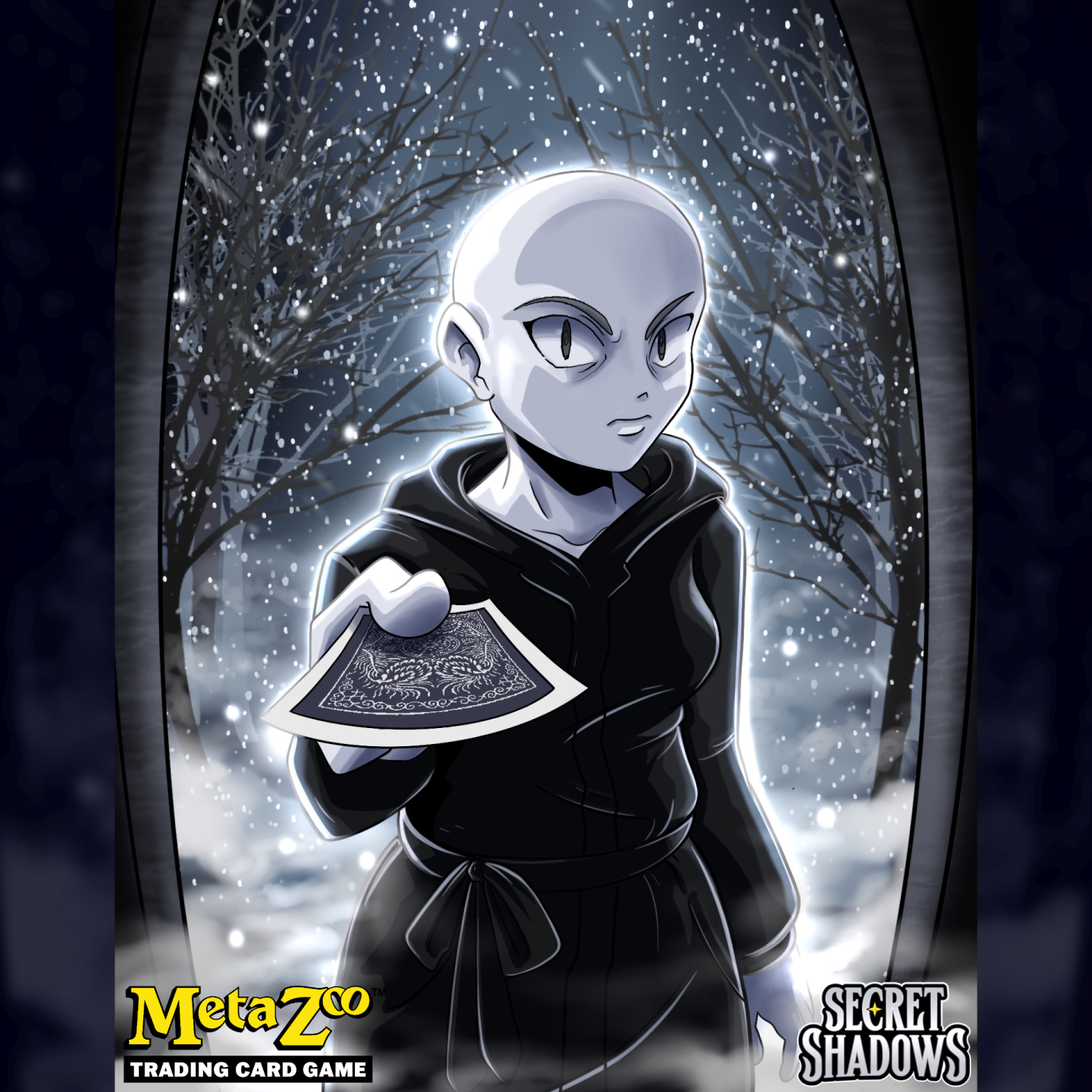
The wind shoved the door open, and snow rushed in to fill the void of the entryway. It parted like a river as it flew around the gigantic figure in the doorway, her albino features nearly camouflaged in the white void of the Montana night.
“Abhibhaavak,” I said. The word came back to me, even after thirty years. “Namaste.”
She didn’t respond to the greeting; she simply held out one hand with an old familiar card in it. I accepted it, looking down at the image of a kelpie named Arthur.
“He’s gone, then?” I asked. “Blake? Does he live?”
She turned her head from side to side. It seemed a gesture of mourning.
My own heart hitched.
“Dhanyabad,” I said, mangling the Nepali pronunciation. “Thank you.”
She dropped her gaze and then her chin. Her lips pulled apart as if she’d not used them in a long time, and she sighed a small cloud of air.
“Goodbye,” she said in a cracked voice that was neither male nor female.
“Alvida, abhibhaavak,” I answered in kind.
She turned and practically drifted down the icy steps of my porch, leaving no tracks behind in the building snow. I put Arthur’s card in the pocket of my vest, wondering for a moment if I would ever call him to me to ask what he and Blake had spoken of in that last hour. But I also thought that I was neither father nor son to them, and now that I was in my fifties with no children of my own, it was perhaps a matter of the heart that was none of my business or understanding.
The abhibhaavak faded into the snowstorm, and Blake the Black faded to white.