
Prologue
At the time we reached Dracula’s castle in late February of 1942, I was in a quiet panic because I was certain that the vampire had moved on to a new lair—but had left a trail for us to follow. I had heard his voice in my dreams, but my waking anxieties erased them so quickly that I could never remember them. I would jolt awake, reaching for the spellbook I had recovered in Nepal and was bringing back to him, and by then, his words had faded into a fog. I would instead focus on escaping the ones who chased us.
In Bucharest, Whitnail had read to me a series of articles in the newspapers that strongly suggested Dracula had been in the city, treating its exuberant nightlife on the boulevard Calea Victoriei like a smorgasbord. In the shifting tides of war, there was always a margin for the missing people, as if the conflict’s tide carried away some expected quantity of flotsam without explanation.
He had been careful—no children were listed among the missing. None of the uniformed soldiers in the service of the Axis disappeared. In either case, the anomaly would have elicited a public outcry and an organized search across the city. But among nearly a million people, the disappearance of a few dozen healthy men and women with boring, everyday lives and meaningless family connections went ignored by everyone but their kin.
We tried to be lost in Bucharest as well. It bought us a few days, but soon enough, Whitnail returned to our room at Hotel Capșa and said to me, “They are in the city now.”
So, we left false trails for them to find and pursue, hoping to keep them in the capital long enough for us to catch a train north into the Carpathian Mountains. I even checked into the central diplomatic hotel, the Athénée Palace, under my late brother Elijah’s name, and I left a blank card hidden in wardrobe for them to “find.” Still, they undoubtedly knew where we were headed and could have lain in wait for us along the trail, but I suspected the harsh weather convinced them they could catch us in the relative urban warmth before we ventured into the bitter rural cold.
“I am in favor of urban warmth,” Whitnail said as we packed again, “if we are voting.”
The rural lands were, indeed, bitterly cold.
***
The American, who was called Stein, sat atop one of the empty coffins with his rifle across his knees while Whitnail and I searched through the dark, cavernous catacombs beneath Poenari Castle. I already suspected we wouldn’t find anything of worth—Stein had clearly been here for some time, judging from the excessive damage he had caused and from his incessant monologue. But he’d come looking for one thing, and I was here for another. I still had hope.
As I splashed through the ankle-deep water to the next coffin, Stein said, “Sorry ’bout that. He really is a sad little cryptid.”
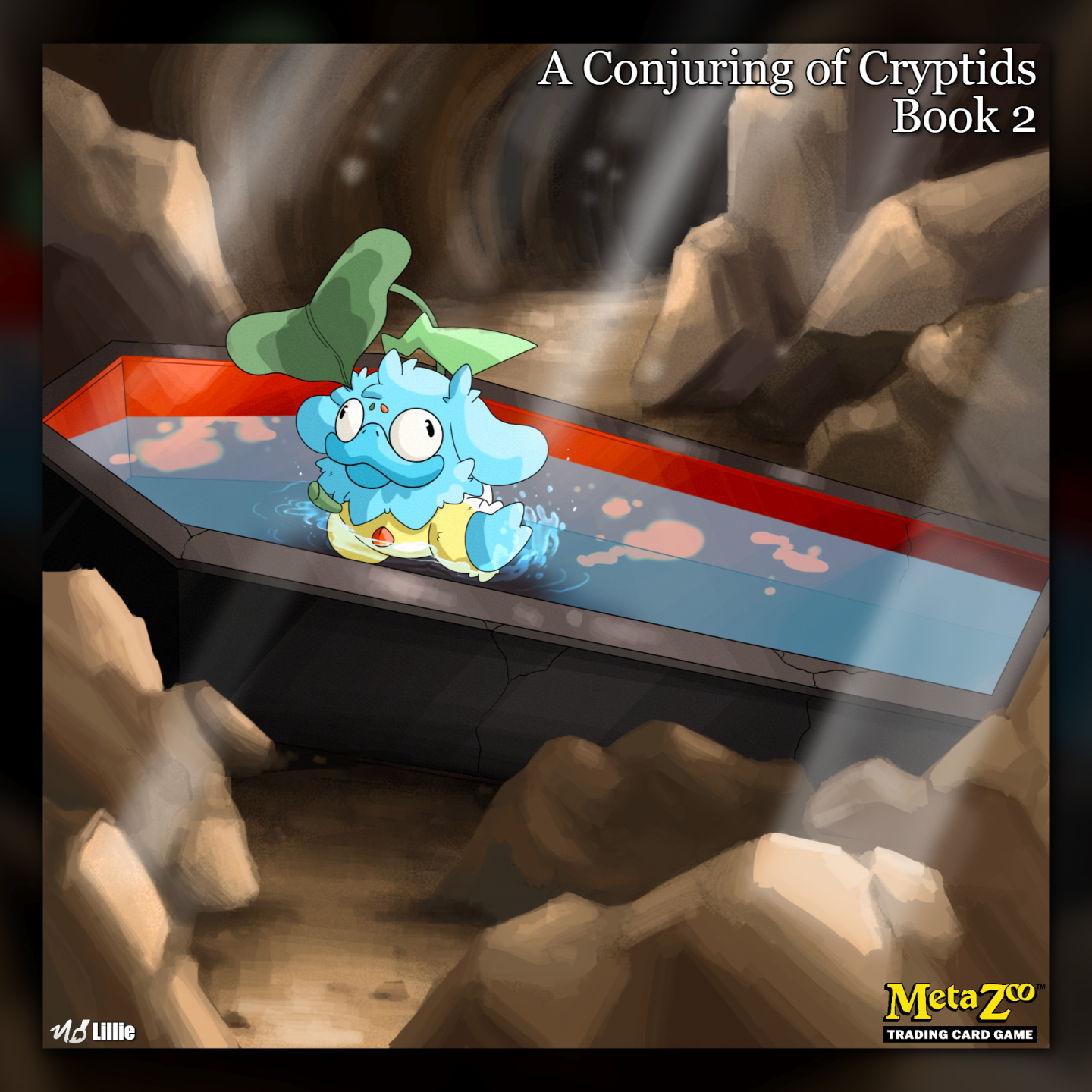
I glanced over at the creature he’d described as Squonk, a malformed blue-green mutt of a cryptid, where it sat on its haunches at Stein’s heel and bawled inconsolably. Its tears were endless, and in that regard, it was like a sink’s faucet left to run until it floods the kitchen. Much of Dracula’s crypts was now under at least seven centimeters of water, more in some places. Whitnail, looking through coffins in the next chamber, sloshed into view, ducked his head under the low archway, and aimed the beam of his torch at Squonk.
“Why is it so sad?” he asked. “Is it because it is so ugly?”
This inquiry renewed Squonk’s vigor in weeping. Lolling in an empty coffin full of tears, our snipe Arthur meeped disapprovingly and splashed her annoyance.
We had found Stein in the ruined castle’s catacombs after we passed through the village of Căpățânenii Pământeni in the Carpathian Mountains. The path up to the castle was no easier than it had been the first time I came, though this time I found along the trail a discarded can, empty, with a peeled-back top emblazoned with the words SUPPER, B UNIT, C-RATION. The discovery was enough to prompt Whitnail to unpack our rifle, for which we had acquired ten-round magazines in Bucharest.
“We won’t be shooting someone for littering,” I said.
Whitnail, checking the magazine, said, “But they may try to shoot us for noticing their littering.”
When we entered the vampire’s lair through the collapsing entryway where I’d first seen Vlad the Impaler, Stein came forward from the darkness to meet us. Thankfully, he came unarmed; he’d left his rifle back inside the crypts. This was a good thing, as Whitnail might have opened fire if he’d seen a weapon and seemed inclined to even without seeing such. But Stein was not a soldier; he was a caster in search of a cryptid—specifically, Vlad III, Dracula—and once he discovered that we spoke English, he could not be stifled. He proceeded to describe his journey from Lisbon to Turkey and from Istanbul to Romania.
“It wasn’t like I was expecting it to be a cakewalk,” he said as he followed us into the tombs, “but it never even crossed my mind that he’d take off ten minutes after I got here.”
We paused. I armed myself with a silver cross and Whitnail lit a flaming firebrand to hold in one hand and prepared a silver dagger for the other, strapping the rifle across his back. Our snipe rode on Whitnail’s shoulder holding the dagger’s sheath with grave conviction. I turned to the young man who’d met us. “Are you saying he flew away?”
“What? No, not that I know about. Why do you ask that?”
“Because you said—”
“Oh,” Stein said, grinning, “I got it. ‘Take off’ means split, vamoose. Leave. He left. Dracula left.”
I caught Whitnail’s eye and used my own eyes to gently indicate the man. His coat, a drab greenish-brown woolen military one, was open at the collar, and the two marks on his throat were painfully obvious. They no longer bled, but they were still brutish wounds that suggested they were inflicted in the middle of a struggle.
“Where did he go?” I asked Dracula’s servant.
“I don’t know,” he said, scratching the side of his nose. “He wasn’t the chatting sort. I came here to map him, but he wasn’t having none of that.”
I reacted to the word map, but Whitnail was quicker to respond.
“You are an American,” Whitnail said.
“You bet. The name’s Stein. From New York City. You can hear my accent?”
“No,” Whitnail said, “your double negative.”
Stein, we would come to find out, was beyond offending. “My father would shake his head and cut me out of the family business. Sorry ’bout that.”
I held my tongue and let the reference to mapping steep a bit longer.
We splashed into the tombs then, Whitnail stumbling in surprise and dropping the firebrand. When the flame went out, we both brought out torches—flashlights—instead. In the crisscrossing beams of light, we could see empty masonry platforms where coffins had once rested or coffins with their half-lids thrown open to reveal the vacant compartments within. Rats fled from the lights. And everywhere, there was water.
We could hear weeping even before we turned our lights on the blue-green cryptid that huddled in the darkness, shedding copious liters of tears and flooding the dank, hollow vaults beneath Poenari Castle. When Stein picked up his rifle—Whitnail watched him with an unreadable expression that I could still recognize as cautionary just the same—and he climbed atop a coffin to sit, the crying creature joined him.
“This is Squonk,” Stein said. “I mapped him in Pennsylvania. Stateside.”
Squonk wailed. Its tears jetted three meters in either direction.
“Squonk and Stein,” I said to Whitnail. “That’s funny.”
“What is?” he asked, pushing a lid aside to inspect an empty coffin. Arthur the snipe climbed down into it, splashing in the tears soaking the coffin’s padding.
“Their names—Squonk and Stein. It’s like ‘Frankenstein,’ see?”
Whitnail blinked down at me. “Yes, I see, but why is that funny?”
I gave up. Whitnail moved deeper into the tombs, opening coffins as he went. Still, I knew he wouldn’t find Elena, the girl I’d met in the village Căpățânenii Pământeni many months ago and who Dracula had taken as a hostage until I returned with his stolen spellbook. I was here now, his vile tome in my pack, but of course, he was not here to receive me. He’d left the American in his stead.
“How long ago did he leave?” I asked Stein.
Stein squinted as he thought. “I’d say it’s been a week. Maybe a little more.”
“Did he go alone?”
“No, no, he took the French girl with him.”
Whitnail rejoined us then, so I left my question for a moment so that we could huddle and exchange whispers with one eye on the American. He seemed ready to burst into monologue if we gave him leeway. Whitnail alerted me to three coffins in the next antechamber, all of them empty, and a stairway that appeared to ascend into the castle ruins above, blocked by a sizable boulder broken from the earth around it.
“I would say it likely that the vampire barricaded the stairs,” Whitnail said. “It does not appear to be a natural occurrence.”
There was nothing else back there, he assured me, so I was comforted by the fact that at least no one would be sneaking up behind us. We turned back to Stein.
“Perhaps you could put away Squonk,” I said.
“He’s my friend,” Stein countered. He gestured at Arthur. “You gonna put away your snipe?”
I sighed. “Never mind then. So, you’re a caster. You came across the water to map Dracula, but you didn’t catch him unawares. Tell us what happened. Did he leave you here to wait for us?”
Now Stein paled visibly. “Yeah, I guess so. He was upset—said Abraham wasn’t dreaming the right way. Along those lines. Are you him?”
“Yes. I’m Abraham. That’s Whitnail.” I could see out of the corner of my eye that Whitnail was arming himself with the silver dagger again. If Stein proved to be a trap in human—or inhuman—form, he was about to be sprung. “Very well, then. What is your purpose now? You can tell me.”
Stein licked his lips. “He said, ‘I’ll go see. I will kill him.’”
Whitnail shook his head; it meant nothing to him, either. I tried to remain calm and in control. “I understand. Who is he going to see?”
Poor Stein’s expression shifted to a man beyond his intellectual depth asked to explain to the professor. He seemed almost panicked. “I don’t know. I know he wanted me to hear and to tell you, I guess, but he wasn’t even talking to me. He was talking to the French girl.”
“Tell me about her.”
“I never spoke to her. He called her Elena.”
Squonk’s never-ending cascade of tears was drowned out in my head by the sound of my own heart pounding. Elena Popa, the first girl I had ever loved, was still alive, though still in the custody of history’s most notorious vampire. Just the same, relief made me tremble in ways the winter weather could not.
“She’s not French, Stein. She’s Romanian. What gave you the impression she was French?”
Stein shrugged, still a man hoping to shift the conversation to something he understood. “He called her belle. That’s French for beautiful, ain’t it?”
Whitnail made a disgusted noise, and I reached under my eyepatch and rubbed where my eye used to be. Something was off here. There had to be a trap or a message or some kind of answer that would put us on Dracula’s trail. He didn’t leave Stein behind to present riddles to us—he would expect me to understand and to continue trying to deliver his spellbook. There was no other reason to take Elena with him.
“Tell me again what he said.”
Stein repeated it twice, but the second time, he noted, “He said it to her. The girl. He called her belle, and told her, ‘I’ll go see. I will kill him.’”
I repeated it under my breath. Belle, I’ll go see. I will kill him. Belle, I’ll go see. I will kill him.
And then I heard it, Dracula’s actual message, at the same time as I heard a male voice suddenly call out from the tunnel that led beyond the underground tombs.
“Halloooo?” it echoed to us in a German accent. “Are you zerr?”
Even Squonk fell silent. None of us spoke until finally Whitnail cleared his throat.
“Well,” he said, “they made very good time.”
I closed my eyes for a moment, moving puzzle pieces around in my head as I imagined the two figures that had chased us across Europe now moving into the shadows of the castle ruins, trapping us. The German caster and the thing that was my sister.
“Dracula has gone to America,” I announced, opening my eyes again. “So, if we can get out of this, we’re going there, too.”