
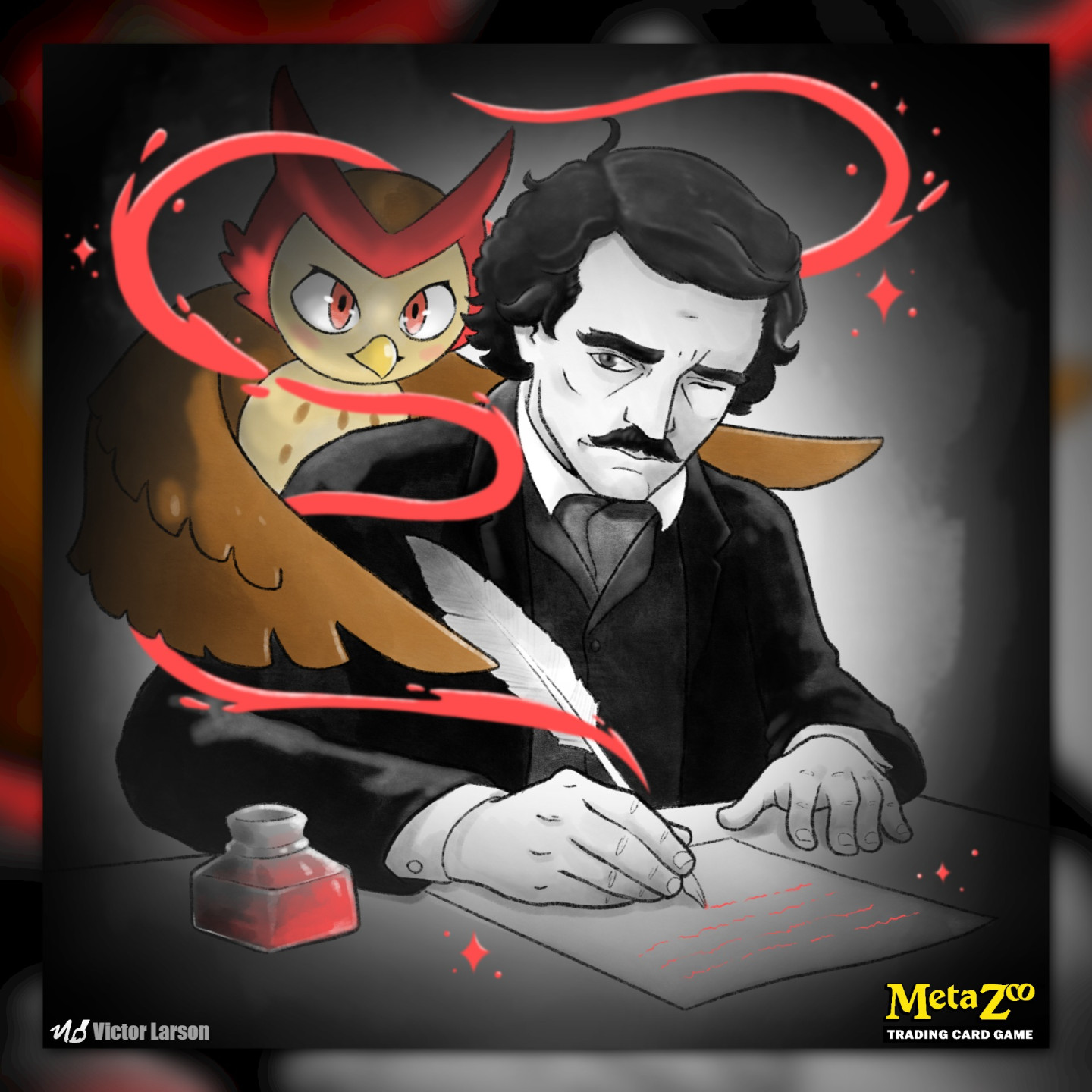
From the Archives
27: Everyday I Write the Book
Cryptids, despite what many of my brethren seem to think, are not toys. Nor are they servants to carry luggage or mop floors. The relationship between caster and cryptid is a symbiotic one—and one that grows exponentially more complicated as the caster pursues the relationship with the mapped cryptid they carry around in a spellbook. To disrespect that relationship is to be embarrassed by it ultimately.
Only 975 tales to go.
Mr. Tremont, a man of great seriousness, waited until the thief-about-to-turn-murderer faced him before he spoke. The night sky had turned foul with rain, and the desperation in young Jancy’s eyes, the risk the boy was taking, inspired Tremont to find the words to soothe the soul and de-escalate the inevitable. Slowly extending a hand toward the young thief, Tremont said…
Like all of the truly memorable moments in literature, these lines didn’t come solely from my imagination, though I carry them around in my head, waiting to write them down. I composed these in my thoughts to be the last paragraph of my book—the one I’ve not started yet—with the final line to be provided by an outside force, one that is so mysterious and omnipresent that it almost defies explanation: a creature of some sort. A cryptid.
At the time, I knew a little bit about cryptids in general. I had seen a snipe on the Woolwich Ferry early one morning, and this opened the door to my research into a world of beings that most of us think of as larks, as urban legends, as myths to be written about in grade school.
But that drop of red. I looked for it to highlight key lines in great works of writing, as if the influence of that red highlighting—that red ink tracing the letters in any reproduction of a famous line—could not be overlooked by the eager and opened eye, which mine was.
Here, on a piece of paper right now, I write these words:
Ask not for whom the bell tolls.
It’s the poet John Donne, made famous anew by Ernest Hemingway. And when I focus, I am certain I see a pale tint of red around those words—the presence of red ink, a perpetual indication of the hand of the divine (or the quill of the divine, if you prefer). It’s only there for a blink, but I’m sure I see it.
I’m certain that this literary cryptid has been around and unseen for centuries, secretly impacting some of the most impressive written words in the world, and once you know what to look for, I have decided, its influence is impossible to miss—assuming, of course, that you are attracted to literature at all. I’m sure the more mathematically minded casters would neither notice nor care about this cryptid. I first realized it even existed when I was in college in the UK, where I encountered an early draft of a work by Charles Dickens, A Tale of Two Cities, circa 1858:
It was a time for good things, it was a time for bad things.
If I were a literary critic, I would say UGH and DAMN. This little gem was buried in the stacks of the British Library in London, a separate page inserted between the pages of another handwritten draft. I don’t know if anyone has seen it in many decades or if historians dismissed it at some point. But…it put me on the path of an external being because it was so painfully obvious that something had happened between that early draft and the final novel, something likely beyond Dickens’s imagination. Once I attuned my senses, I came upon a handful of other interesting shifts in noteworthy lines from literature:
I’m called Ishmael, if you must know me by a name.
Some animals are just better than others.
To live or to die. Is that the question?
All of these should have been tagged with *Final text may vary.
I had an English professor, one of those leather patches on the elbows types, the ones who’ve published a short story in The New Yorker and think paper was created to capture their thoughts, who told me once that I was an arrogant punk when it came to my assumptions about literature. Me? First of all, I looked like Anne of Green Gables. I wrote a paper in psych class on introverts, but I was too scared to turn it in. I wrote in a diary with a unicorn on the cover until I was twenty. Punk? I felt Professor Hornsby was angry at me just because I was digging deep into literature’s origins, and he wanted to protect its reputation.
And I was sure he didn’t want the world to know about the true source of his creative spark.
If you think of this literary influencer—one that borders on the celestial—as a source that cannot be summoned, cannot be commanded, and cannot be controlled, you come to determine that you’re talking about inspiration. Not in the truly religious sense, yet one that a writer—like me, like Professor Hornsby, like Charles Dickens—would consider divine. A red deity, one that is divine and waiting to be divined.
The more I searched for it and its secrets—in the work of musicians who wrote lyrics that will stand the test of time (“The movement you need is on your shoulder” was destined to be a placeholder line until Lennon, under the literary cryptid’s mysterious influence, convinced McCartney to keep it) to poets who were on the verge of a historical blunder (“Quoth the pigeon, ‘nevermore’”)—the more I knew I had to find this being and sway it to guide me to a line of everlasting import.
This was my first encounter with the true power of cryptids, which led inevitably to my deeper consideration of casters—those rare would-be magicians who, in addition to their ordinary lives as surgeons or grain operators or librarians, can see and so pursue, find, and map cryptids. Mapping is the act of capturing an infinitesimal fragment of a cryptid’s essence—its being, its soul, its existence—and storing it in a specially created card. The true cryptid goes along its merry way, but the mapped cryptid, mixed with the essence of the caster mapping it, is now agreeably in service to the caster.
All of this is so much gobbledygook to explain how I came to believe I could force the cryptid into guiding me to write a masterpiece line of literature. I knew I was a caster because I had seen a snipe on the Woolwich Ferry early one morning.
But this begged the question: How does one find this literary being?
Enter Professor Wilbur Hornsby. Again.
Aside from being a literary snob and a middling writer, Dr. Hornsby seemed to have an infrequent gift. His works had been selected as one of the year’s best American short stories for two consecutive years, and he’d been an honorable mention three other times. I have to say, I’m not sure why. Consider this line:
The Decker twins were a pair of boobs in search of a mastectomy.
Is that the cryptid’s work? No, I think that’s the work of Red Bull and red wine. But when I did a bit of research, I found that one of Dr. Hornsby’s opening lines was repeatedly cited as “a great literary sentence.”
He had a hairy face that he finally stopped trying to hide from his clients.
Is this work of the cryptid? Possibly. It did not strike me as a divine gift, and so I personally couldn’t see the literary value of it. A ship of fools called critics did, however, so I decided Hornsby had at least a tangential relationship with the cryptid, and if I could be there when it came to him, I decided I could map it and make it my own. And then? Well, then, I would have my own mapped version to guide me in writing a sentence that would join the ranks of the greatest ones ever written. Simple. Elegant. Profound. Consider this line I discovered in a biography called Foregoing Frost about an early draft of the poem “The Road Not Taken”:
The road split and went east and west, so I, I took the harder one;
And that brought me here.
The red literary cryptid clearly refined this, in my opinion, guiding Robert Frost’s hand to achieve a thought still relevant over a hundred years later.
I planted a caster’s card in Hornsby’s office, directly in line with his door. Between the hours of 1:00 and 5:00 three days a week, the good doctor would write, and he kept a sign on his door during that time:
DO NOT DISTURB UNLESS…
- You are on fire
- You have freshly baked German chocolate cake
- You’re from the Pulitzer Prize Board
I also hid a spy camera the size of a dime, by which I suspected I would be able to spot the crimson cryptid, only visible to a caster, join him when he was deepest in his composing.
Then, for three weeks, I sat on a bench just down the hallway from Dr. Hornsby’s closed office door and rude signage, watching the transmission from my spy camera, vigilant for the first sign of the appearance of this cryptid. For emphasis, let me say again: Three weeks I sat there. I learned a great deal of useless information about the professor that served me less than well: He played a lot of Roblox online when he should have been writing. He ate an entire box of Little Debbie Nutty Buddy Bars each week, one every single hour, four each day, Monday, Wednesday, and Friday. He spent a decent amount of time reading an online cartoon strip called Cornucopia about a scarecrow running a corn farm that was close to being the stupidest comic I’d ever scanned.
And then, one Friday afternoon at 4:58, it happened: a red dot seemed to hover in the air above Hornsby’s receding hairline, and he paused. The nearly invisible drop of red ink circled him. I know what I saw. His fingers froze above the keyboard, and his head tilted just a bit as he considered the screen before him. He seemed almost catatonic. The whole thing happened in an instant, in less time than I have spent describing it.
When I burst in, Hornsby bolted upright and shouted in a great barrel of a voice that completely belied his nerdy form and demeanor, and had I not been so focused on mapping this Red Ink, I might have retreated in fear. But in only seconds, I had opened the path between the card and me, the gateway that brought a cryptid’s essence to a caster’s and then into the card at the other end, and before my fight-or-flight reflex kicked in (on flight, of course), I thought I had mapped Red Ink. And it vanished from sight even before Dr. Hornsby took another deep breath to bellow.
“Miss Braxton!” he roared. “What do you think—?”
I didn’t think anything. I just fled.
As the line originally read, “Don’t ask who the bell tolls for—it’s probably you.”
I know the poet John Donne looked at that line and thought to himself, DAMN IT, THAT’S BAD.
But at least it got better later on.
***
So, that was last night. Campus security came to my dorm this afternoon to ask why I burst into Professor Hornsby’s office, and my answer was that I needed to talk to him about my grade, and I thought it was after five o’clock. They didn’t believe me, of course, and one of the two campus cops said I should definitely be worried about my grade now.
I despaired. They thought it was about the likely academic revenge of Wilbur Hornsby against me, so I let them believe that. But my dejection actually came from the discovery the night before that I had not mapped Red Ink. It had somehow evaded me, dismissed me, or rejected me, leaving me with a blank card and no cryptid to guide my writing.
That, I have slowly come to realize, is how it is meant to be.
Does a holy book embody the divine? Were that the case, humanity would have no need for temples, churches, or holy places to visit, where we might commune with the deities. We would have our gods in our homes, nestled between pages in a book, and we would open them up for casual interactions with the greatest powers that be.
My thinking, I know now, has been all wrong. I have underestimated what a force like Red Ink is capable of giving—or denying.
When we see higher intervention, we go to the holy place, and there we say the holy words. We pray, we acknowledge our limits before greater beings without limits, and we ask for their guidance. We don’t map them; we don’t trick them. We don’t take them for our own.
So.
I am in the campus library, in a small chamber at the back of the third floor, where my literary devotional won’t be interrupted or questioned. I have a book on the table beside me, The 1,000 Greatest Lines in Literature, which includes those I’ve already mentioned and hundreds more.
My laptop rests before me. Its screen is open to a blank page and a blinking cursor.
I have here, then, in this sacred place, a symbol of my personal faith and a means of transcribing whatever Red Ink might deign to bestow upon me. I position my fingers on the home row, and I whisper to the celestial cryptid whose color I have personally seen.
Write me a line that will make my work a masterpiece.
Yet I feel no inspiration.
Help me create the final line of the novel I will write. It will be the line that defines my generation. Please, Red Ink, write my soul.
And then I can feel its presence. It’s in the sweat on my brow—
Writing is easy. You only need to stare at a blank piece of paper until drops of blood form on your forehead.
—and I have no doubt at all that it will guide my fingers because I have done everything I think I must to merit its reward. I begin to type that last paragraph, the one I’ve carried in my head for months now. It’s time for Red Ink’s genius to guide my creativity. I have asked for this, and it is due to me. I feel a culmination, what I imagine the faithful have always felt when beneficent awards await, but they fear their strength is not enough to hold the bounty. I am strong enough, though. I know I am. I must be. I have come so far. It has to be far enough.
Mr. Tremont, a man of great seriousness, waited until the thief-about-to-turn-murderer faced him before he spoke. The desperation in young Jancy’s eyes, the risk the boy was taking, inspired Tremont to find the words to soothe the soul and de-escalate the inevitable. Slowly extending a hand toward the young thief, Tremont said…
And the moment comes, just as I’d expected, just as I’d prayed for.
Slowly extending a hand toward the young thief, Tremont said, “Tickle my fancy, Jancy, and be done with these chancies on this dark and stormy night.”
…
I look at the words, the ones Red Ink has given me in my impious moment, and I think: UGH. DAMN IT.